From Windfall to Warning: Western Pennsylvania Infrastructure Faces the Post-IIJA Reality
Cautious optimism abounded the last time we touched on the topic of infrastructure in the spring of 2023. Congress had recently unleashed over a trillion dollars via the Infrastructure Investment and Jobs Act (IIJA), allowing the states to update and maintain the mundane yet essential systems that keep the country functioning.
And while the good vibes were somewhat tempered by real concerns—chief among them inflation— there was still a sense that a new cycle of public works was gearing up. Now, three years later, with the curtain closing on the IIJA, we can look back on what it helped bring to Western Pennsylvania, what’s still to come, and the significant funding issue that will likely arrive in the fall when it expires.
Passed to tremendous fanfare in 2021 after 13 months of emergency funding extensions, the IIJA replaced the expired Obama-era FAST Act. Heralded as a benchmark in infrastructure spending, the new bill allocated roughly $1.2 trillion over the course of its five-year fiscal window. About half of that continued existing surface transportation programs, with a half a billion extra pulled from the general fund for highways, power, transit, bridges, and water.
That type of dough is dizzying and having it locked in like that gave the states the certainty they needed to plan infrastructure projects years in advance. And they did. Over the past five years, thousands were completed. Across the nation, more than $400 billion was put into surface transportation, $86 billion into transit, and billions more into bridges, airports, and energy.
But the impact didn’t land as cleanly as hoped. Getting a major infrastructure build from paper to pavement takes time, which allowed pandemic induced inflation to claim its pound of flesh.
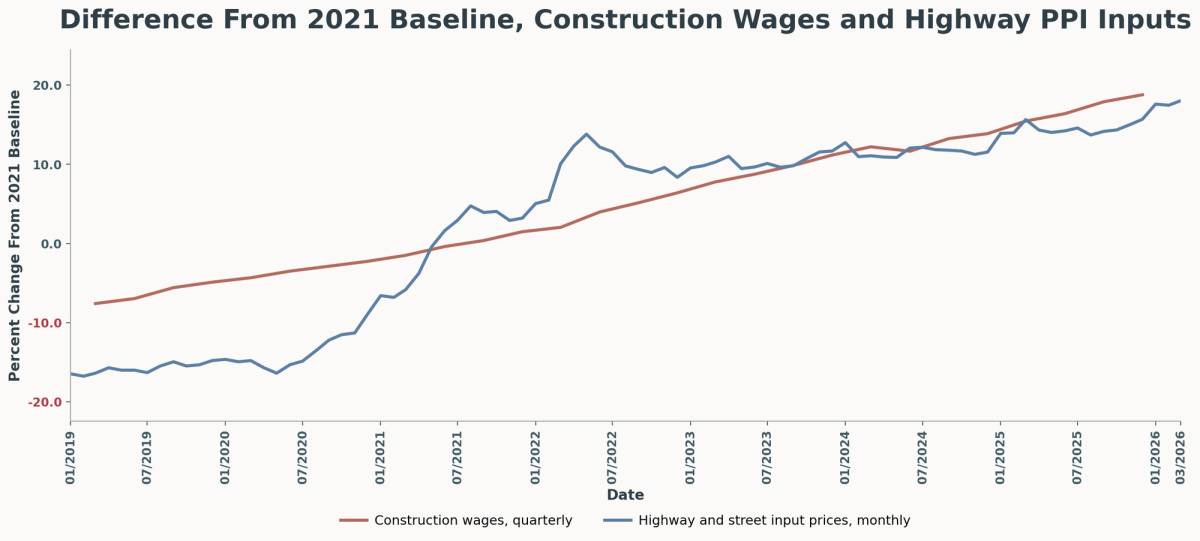
From the start of 2021 to March of 2026, construction costs rose sharply across both materials and labor. A BLS pricing index tracking inputs to highway and street construction increased roughly 26 percent during that time. And over that same period, construction wages rose by just over 20 percent.
Spikes in wages and prices diluted the impact of the IIJA
A 2025 report by the Urban Institute found the IIJA windfall was seriously dulled by the rising construction costs. When adjusted for the pricing spikes, the researchers found only a limited increase in additional highway and street infrastructure was achieved, along with evidence of a decline in passenger and freight rail investment.
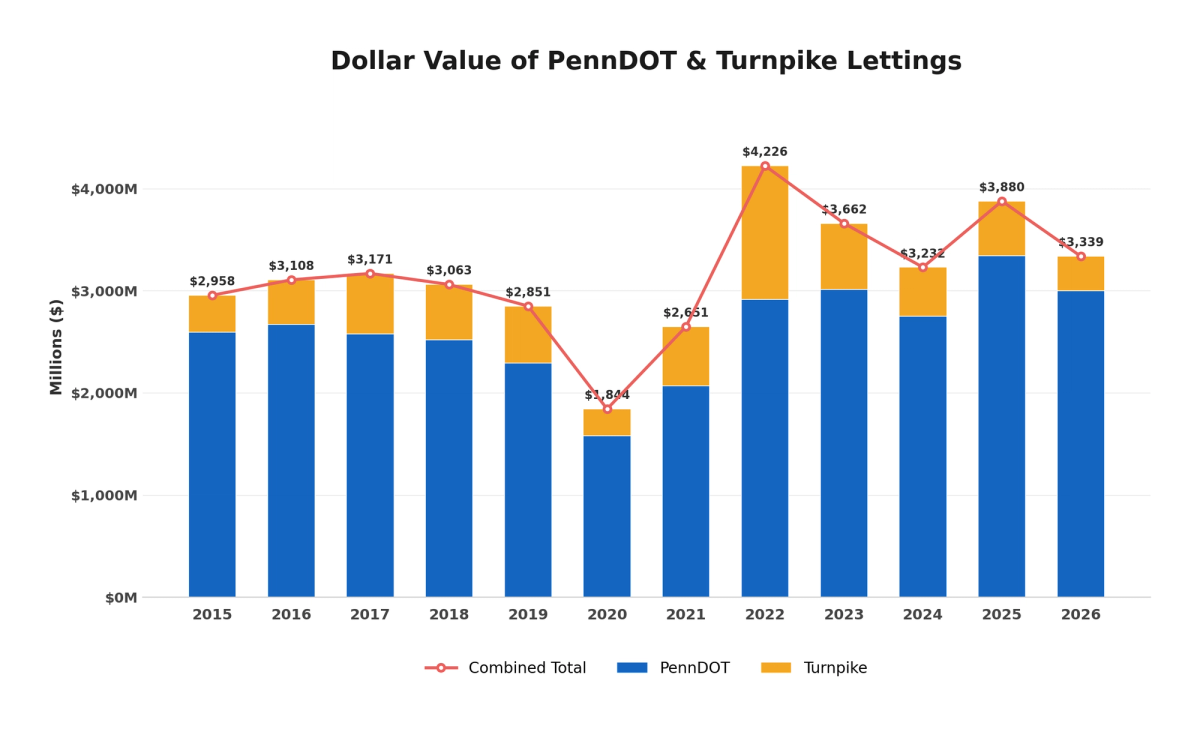
Diluted or not, that money was put to work across Pennsylvania, most notably on its highways. Beginning in 2022, PennDOT lettings jumped dramatically. From 2022 to 2025, annualized highway letting averaged about $3.006 billion, a 19.5 percent jump from the annualized average between 2016-19.
The Surge in IIJA Funding Can Be Seen in PennDOT Highway Letting Totals
However, just because the spigot is on doesn’t mean everyone gets a full cup.
“When you have historic funding, you try to get big things done,” said Rich Barcaskey, President of the Constructors Association of Western Pennsylvania (CAWP).
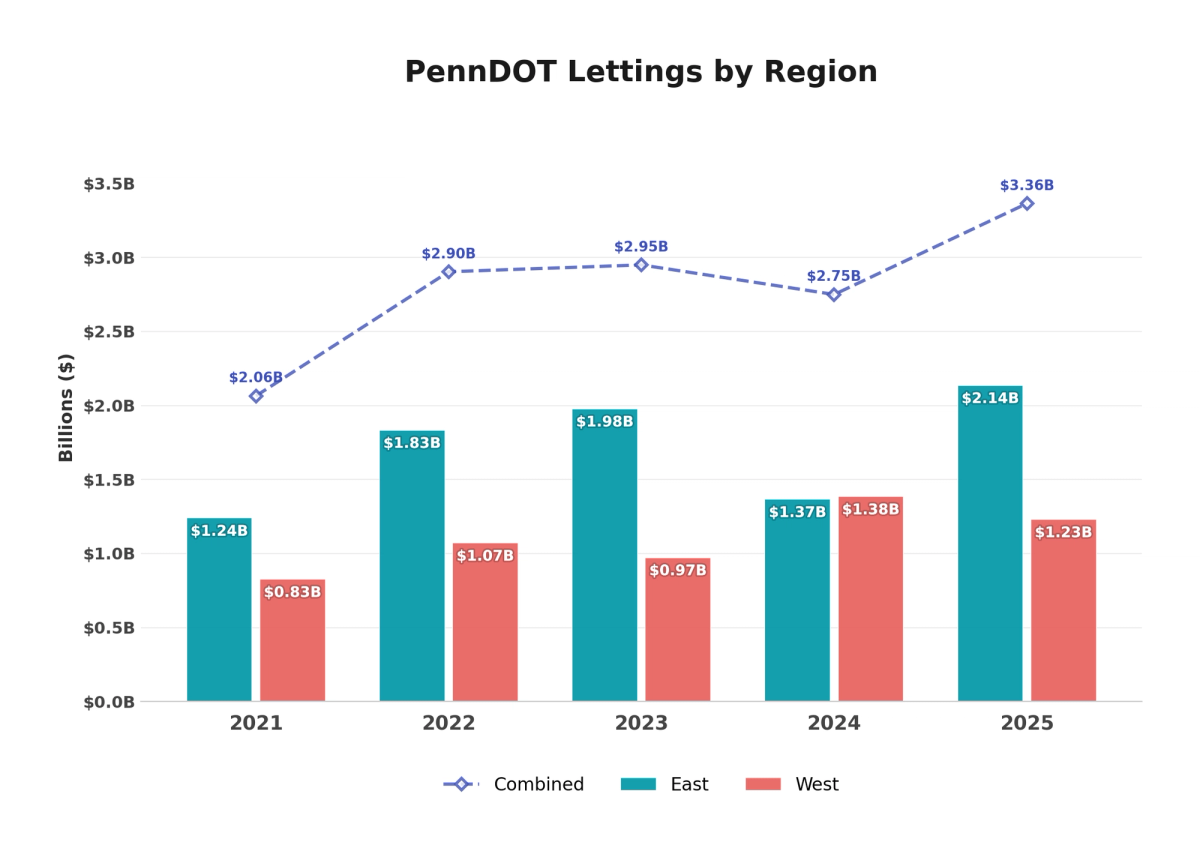
And the state did, in fact, do very big things. Mainly in Philadelphia and Harrisburg. Since 2021, roughly 61 percent of all PennDOT highway lettings were focused on the state’s eastern districts. In 2025, it was nearly 65 to 35 percent split. In 2026, the east/west split will be closer to 70-30.
“Is there more money going into PennDOT highway lettings over the last two years,” said Barcaskey. “Yes. Has it all been coming to Western Pennsylvania? No.”
Eastern PA has received the lion's share of the IIJA windfall
Enough of it came through to get some major road work done. Some brand-new builds, but much of it in unglamorous yet essential maintenance. That is part of the game in infrastructure, says Jason Zang, Executive Director of District 11 for PennDOT.
“It’s like fixing your car. Your car breaks down and you spend $1,200. Then you’re like, ‘What did I get for $1,200. I got the same car.’ That’s what it’s like fixing a bridge sometimes.”
That quote succinctly describes most of the work done across Western Pennsylvania throughout the IIJA’s tenure. Resurfacing, rehabilitating, and stabilizing major roadways. Essentially, handling a hundred different CHECK ENGINE lights across the system.
That’s not meant to be flippant about the essential nature of the highway work PennDOT performed, nor the complexity involved in making these projects happen. The slide-in bridge near the Squirrel Hill tunnel is an absolutely incredible feat of engineering, but it is still replacing an old thing with a new one.
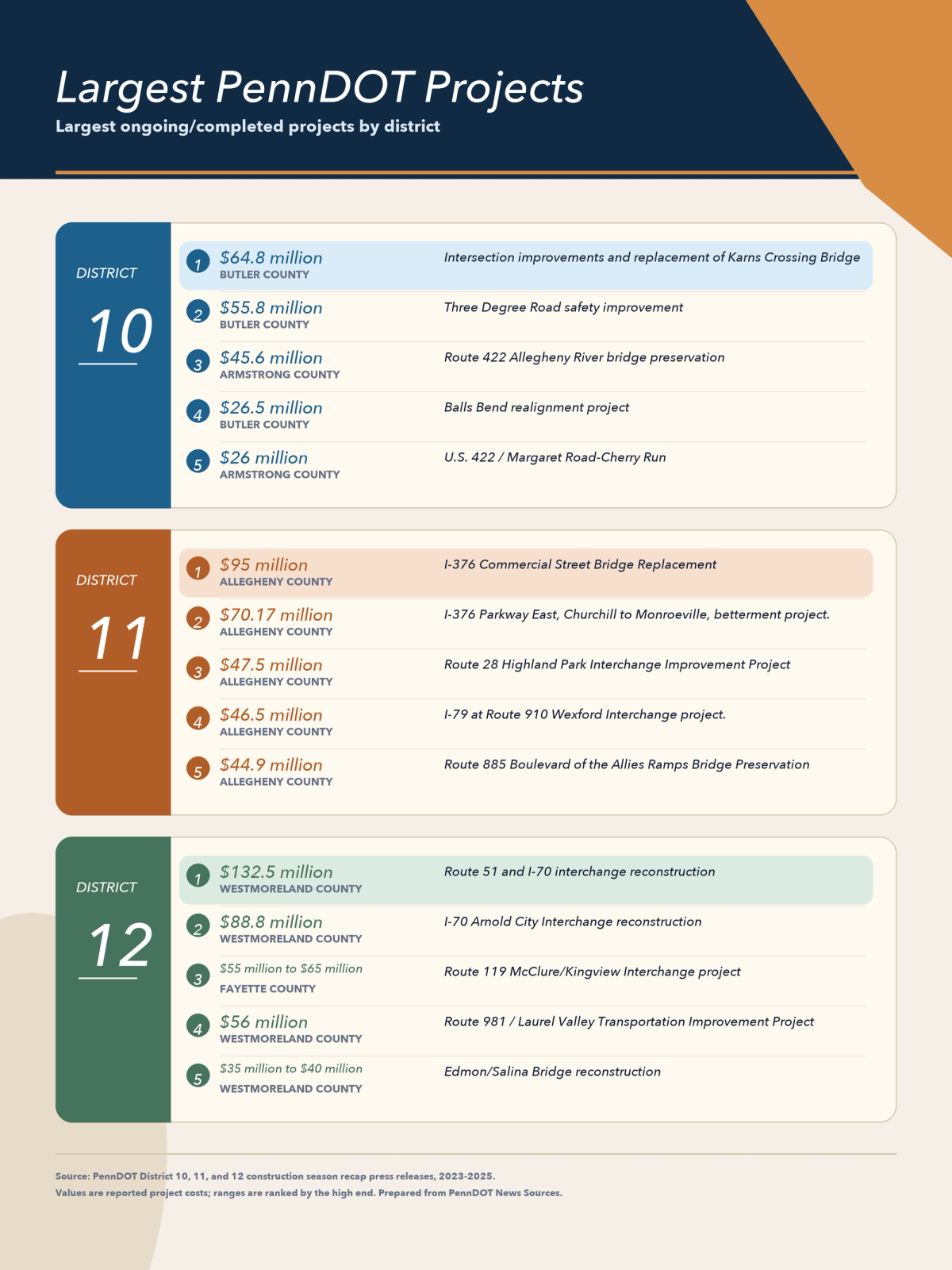
Some Of The Largest IIJA Funded Infrastructure Projects (Source: PennDOT)
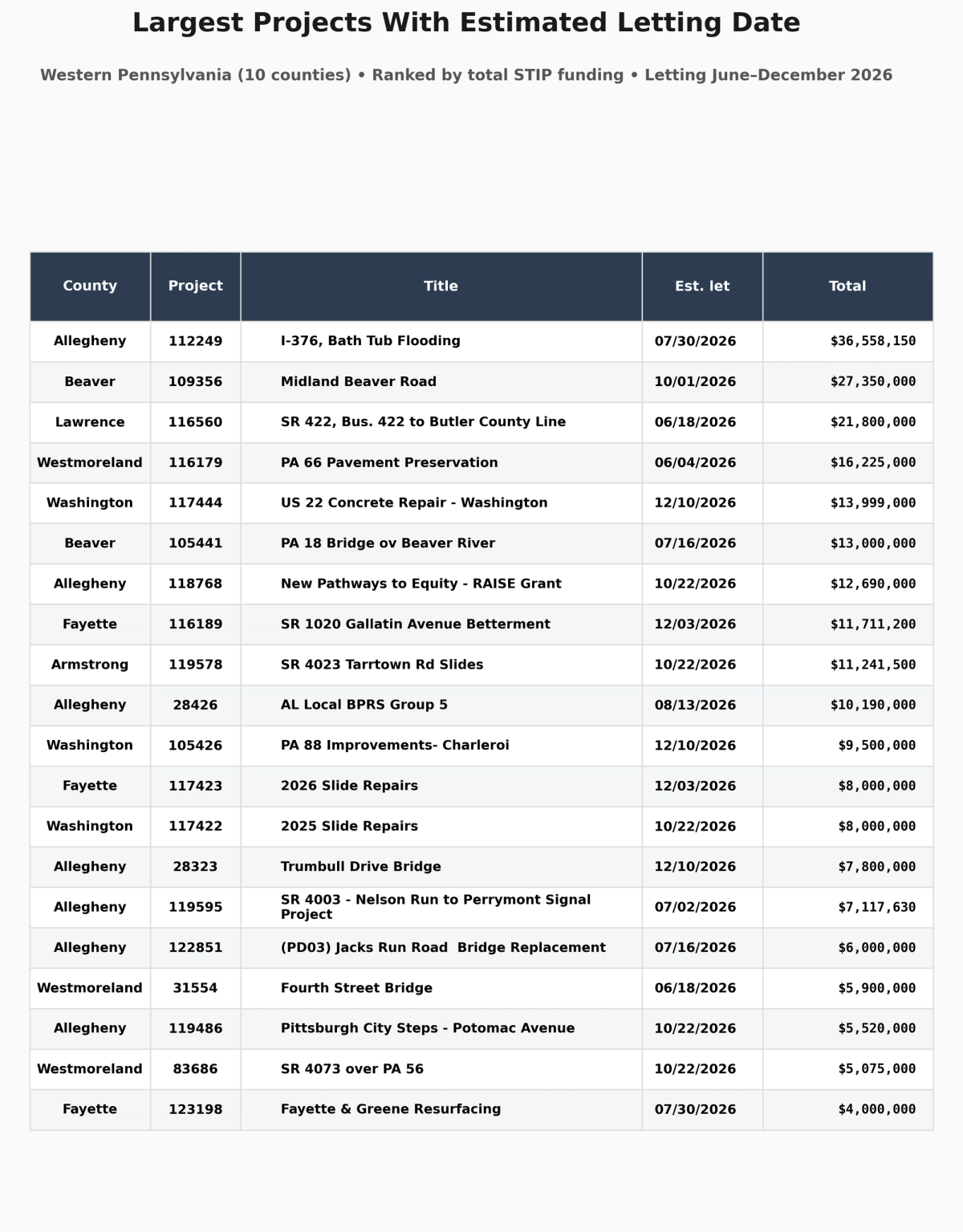
Projects like this—or the $36 million “Bathtub” flood mitigation downtown—are not designed to expand the system, but to keep it from failing. These types of crucial projects are what’s in the pipeline in the coming years as well. PennDOT’s five-yar plan shows the upcoming slate is dominated by corridor repairs, bridge preservation, slide stabilization, and targeted safety upgrades across Allegheny, Beaver, Washington, and Fayette counties.
Source PennDOT
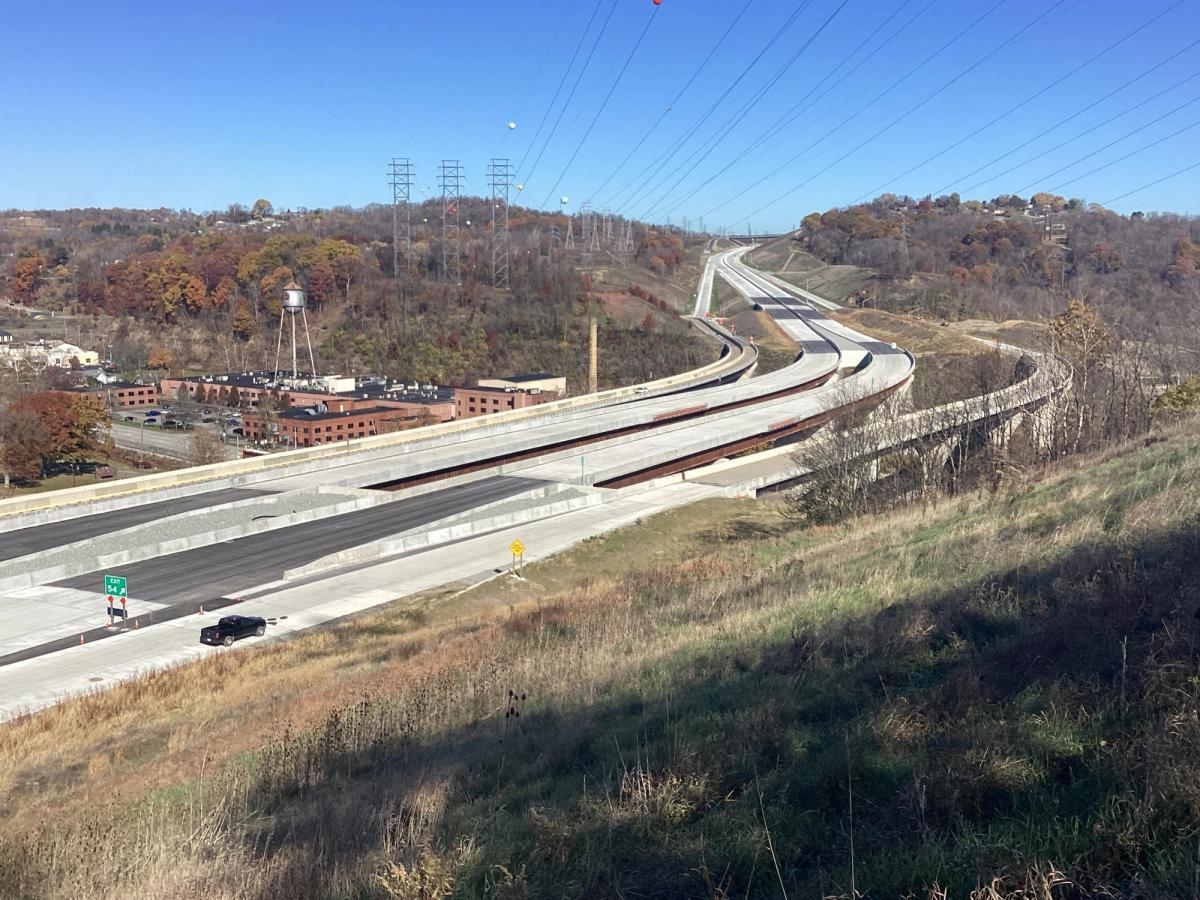
Beyond the purview of PennDOT there was a major expansion of the transportation network. The Mon/Fayette Expressway is a long-running Pennsylvania Turnpike project aimed at reconnecting communities in the Mon Valley that were left economically isolated after the collapse of the steel industry. Built in phases since the late 1980s, the highway currently runs from West Virginia to Jefferson Hills, with construction now advancing north toward I-376 near Pittsburgh.
Bridge work over State Route 51 (ing courtesy of PA Turnpike Commission)
The buildout is happening section by section, with multiple active construction zones between Jefferson Hills and Duquesne that include new interchanges and major roadway infrastructure. Even before the full connection to I-376 is complete, each segment is expected to deliver immediate benefits by shortening travel times, improving local circulation, and reducing dependence on inefficient back roads.
But infrastructure isn’t just roadways. Water and power are essential components of what makes West PA run day to day. And some of the largest projects of the past few years have revolved around them.
The Allegheny County Sanitary Authority’s (ALCOSAN) Clean Water Plan represents one of the most consequential infrastructure efforts underway in the Pittsburgh region, with more than $2 billion in investment aimed at addressing a decades-old problem.
The county still relies heavily on a combined sewer system, where storm and waste water share the same pipes. During heavy rain events, that system becomes overwhelmed, sending untreated overflows into the Allegheny, Monongahela, and Ohio rivers. The plan is designed to dramatically reduce those discharges through a combination of expanded treatment capacity, system upgrades, and regional coordination, bringing the system into compliance with federal water quality standards.
The plan hit a major milestone with the completion of the North End Facilities Project at the Woods Run treatment plant. Completed in 2025, the new facility increases the plant’s secondary treatment capacity from 250 million to 295 million gallons per day, allowing the system to handle significantly higher volumes during wet weather events.
Over the next five years, ALCOSAN will shift into its most complex and capital-intensive phase, centered on construction of a regional tunnel system designed to capture and store excess flows during storm events. This work will be paired with continued upgrades to interceptor lines and conveyance systems to move greater volumes of wastewater to the treatment plant, along with additional improvements to plant operations to handle those flows more efficiently. At the same time, municipalities across the region will continue implementing source control measures, including sewer separation and green infrastructure, aimed at reducing the amount of stormwater entering the system in the first place.
Pittsburgh Water also recently announced they had secured $31.5 million in funding from the Pennsylvania Infrastructure Investment Authority in early 2026 to replace lead service lines in four neighborhoods, while also advancing more than $89 million in water main replacement work across Elliott, Crafton Heights, West End, Hazelwood, South Side Slopes, South Side Flats, and Troy Hill. The 2026–2027 program will replace 11.1 miles of aging water mains, along with 120 fire hydrants, 662 valves, and 1,607 water service lines.
The recent awards are part of a much broader wave of water infrastructure investment occurring across Pennsylvania. In the PENNVEST 2024-2025 Annual Report, they note approving more than $1.08 billion in funding during fiscal year 2024-2025 alone, the largest annual total in the agency’s history. Drinking water projects made up the largest share of that activity, with 74 projects totaling roughly $698 million, while another 46 sewer projects accounted for nearly $295 million.
Another infrastructure component to keep an eye on is power. Construction is now underway on the Homer City data center project, where developers are building a $10 billion, 4.4-gigawatt natural gas-fired power plant alongside a large hyperscale data center campus on the former coal plant site. Roughly 1,200 workers already onsite, and the plant expected to begin producing in 2028. At the same time, the Trump administration recently announced plans for a separate $17 billion natural gas-fired project somewhere in southwestern Pennsylvania that would produce up to 4.3 gigawatts of power.
Both these projects are to feed power to data centers, and artificial intelligence is pushing Pennsylvania’s electric market into a period of major transition. For years, the state benefited from abundant natural gas, a large fleet of coal and nuclear plants, and a relatively stable demand outlook.
But this is changing rapidly as electricity demand is now rising faster than utilities and grid operators expected. Older dispatchable power plants continue to retire, while most new projects entering the pipeline are solar and battery facilities rather than traditional gas-fired generation. Pennsylvania currently has more than 7,100 MW of solar projects and 3,000 MW of battery storage projects waiting in the interconnection queue, compared to only about 372 MW of new natural gas generation.
That is creating a dilemma for grid planners. Solar and batteries can help meet demand, but they do not provide the same around-the-clock reliability as gas, coal, or nuclear plants. As electricity needs rise, the debate in Harrisburg is increasingly shifting from how much power to add to what type of power the state should prioritize.
Making tough choices on what type of infrastructure to fund could be a reoccurring theme in the coming years, so let’s close out by circling back to the beginning. The IIJA will expire in September. If a new bill is not passed before then, there will likely be a noticeable slowdown on infrastructure work in the coming years.
Here’s why: most highway infrastructure funding comes from the Highway Trust Fund (HTF). This pool of money is dispersed across the nation to fund road construction and surface transportation. Its revenue is generated by a $0.193 cent tax on every gallon of gasoline you purchase, and the $0.28 a gallon truckers pay when filling up their rig with diesel.
Those rates were set in the early 90’s and have proven too politically toxic to raise. The problem is that it is no longer near enough. Over the past thirty years, vehicles have become more fuel efficient and development costs have risen significantly, while inflation has eaten away at the contribution value. The tax would have to rise to $0.41 cents and $0.58 cents a gallon today just to match the 1990’s value.
Consequently, the HTF is roughly $20 billion in the red every year and the Association of General Contractors believes that by 2028 the fund will be running a $40 billion annual deficit. This gap is typically covered by Congress reallocating money from the country’s general fund of tax revenue, which is where things like income and business taxes flow into.
While that gets the job done it fundamentally changes the nature of the program. Since the funds are no longer raised solely by drivers via fuel; political machinations enter the picture. Who gets what and where the backfill money come from. That introduces uncertainty about funding, which keeps states from planning too far ahead.
Bills like the IIJA alleviate most of that, until they expire. Then Congress has to periodically provide emergency funding until the next bill passes. If no new infrastructure spending bill is passed between now and October, the last thirty years provide an unpleasant clue as to what will happen next.
In between each of the last five major spending bills were periods of time, ranging from six months to three years, when Congress kicked the can rather than pass a new bill. Since 1997, the federal transportation funding program has operated on short term extensions for roughly 7.5 years.
In our current political climate, skepticism on the odds of a new bill being passed upon the IIJA’s expiration in the months before congressional mid-terms is quite warranted. If nothing is done, then core infrastructure spending will continue being funded through extensions, but historically, this has caused a drop-off in lettings.
And there is a significant chance that even if a compromise is reached and congress passes a new bill; it will be significantly less than the IIJA. Rumors out of D.C. from advocacy groups following such things are that a new spending bill is being fleshed out with a value around $500 billion. This heavily tentative figure is about half of what the IIJA sent into infrastructure.
And there’s more. The IIJA was remarkable in part because of a provision called Division J, which allocated hundreds of billions for infrastructure including an additional $184 billion in general funding to the states through the Department of Transportation. This money cannot be extended in the way that funding for the HFT can. It must be re-legislated, and if it isn’t, it evaporates on October 1st of this year.
For Pennsylvania, that will cut off a lot of bridge repair and maintenance funding. The special pool allocated about $26 billion for bridge repair to be given across the states, and the Commonwealth received about $1.6 billion of it. This enabled the Commonwealth to upgrade and provide much needed maintenance on its 3,000 plus bridges in poor condition.
“We rely on those infrastructure bills,” says Zang. “If something doesn’t get passed, that has a direct impact on the projects that can be designed and constructed. It’s always a balancing act. When you direct funding to bridges, there’s less going to the roads.”
Much of the Division J money was doled out in awards, and it wasn’t just highway related. A look at the IIJA awards tracked by the Brookings Institute through 2024 shows that Pennsylvania received about $20.8 billion, with $14.9 billion in additional funding for transportation, $1.6 billion for broadband, and $1.3 billion for flood control and $1.27 billion for clean water.
Allegheny county received over $462 million, with $142 million going to the eastern Pittsburgh multimodal corridor project, $50 million going to the Bus Rapid Transit corridor build in Downtown, and $20 million toward the airport. Beaver county received $858 million for lock and dam work. PennVEST’s annual report explicitly states their increase in water improvement projects have been driven by IIJA awards.
PennDOT appears to be planning for a drop off in funding assistance from D.C. An examination of the planned lettings data in their 12-year plan shows anticipated lettings peaking this year at $16 billion, then dropping to around $12 billion per year into the 2030’s. (statewide_annual_penndot_lettings_anticipated)
This is a 25 percent baseline percent reduction in the funding used to maintain one of the most complex infrastructure networks in the state. That will be compounded by the likely loss of nearly a billion sent to the western PA region from the Division J funding.
Taken together, the outlook until the next update is now cautiously pessimistic. After a brief surge of historic investment, the next few years will potentially look far more familiar: less certainty, tighter funding, and a continued focus on sustaining an incredibly complex system.