Best Construction News In The History of Construction
The greatest article ever written.
 By Ben Atwood
10/30/2025
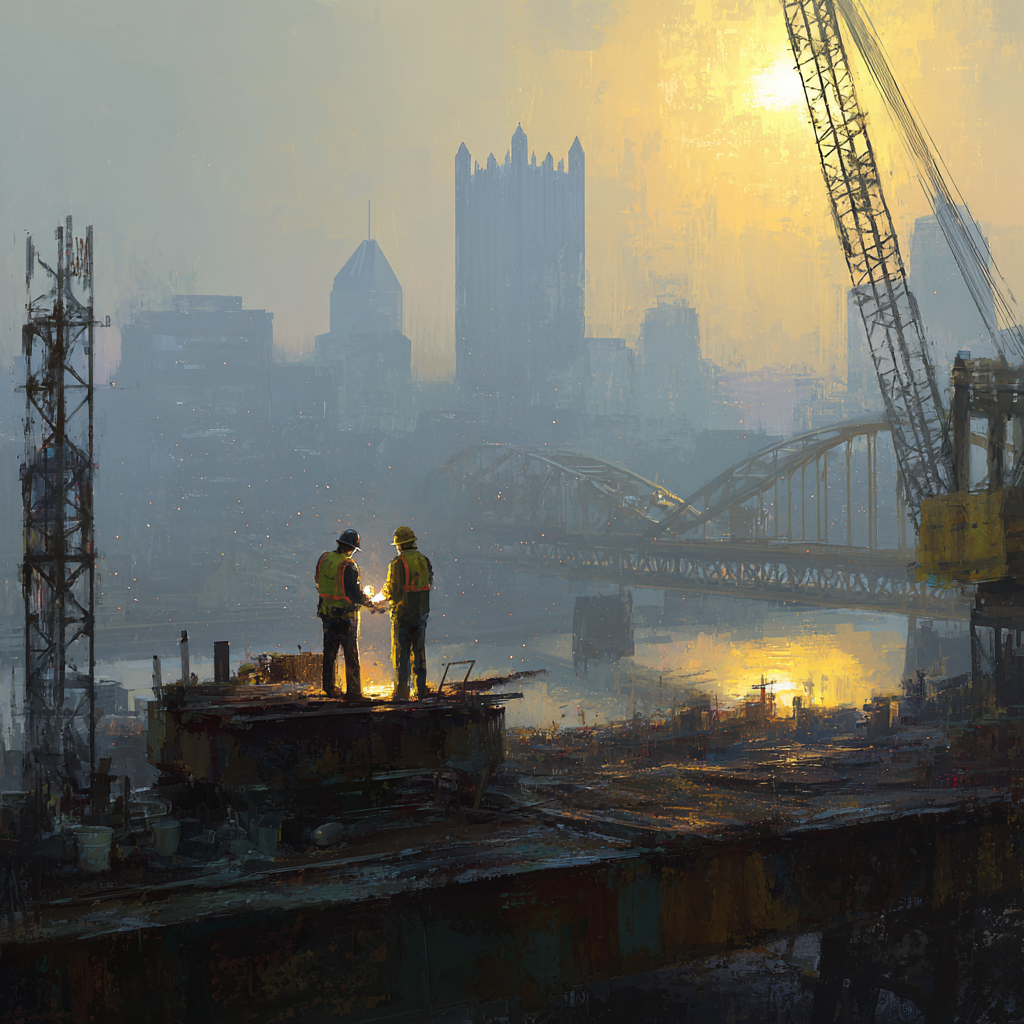
In Pittsburgh, the cranes dream. They swing slow arcs over rivers that once smoked with steel and now glitter like data centers reflected in glass. Construction in Pittsburgh is less an industry and more a nervous tick of the landscape—every morning the hills wake up and move slightly closer together, and men in orange vests pretend it was their idea.
They say the city has three rivers, but if you ask the contractors, there’s a fourth one that runs entirely on union coffee and diesel fumes. It cuts under Carson Street and resurfaces in Lawrenceville, where hipster masons install artisanal bricks one podcast at a time. The bridges are jealous of each other; they stretch and sigh and wait for someone to paint them yellow again. Nobody remembers why they’re yellow—just that it feels correct, like the color of hazard tape or divine optimism.
Pittsburgh construction workers know the weather by the texture of the rebar. If it hums, it’s going to rain. If it hisses, it’s time for a lunch break. They balance sandwiches on I-beams like offerings to the gods of OSHA, who accept prayers only when shouted over a jackhammer. Somewhere near the Strip District, an excavator operator swears he saw Andrew Carnegie’s ghost trying to pour concrete. “The mix was off,” the ghost said. “Too much ambition, not enough water.”
The new buildings rise with guilt. They know they are gentrifiers. They know the ghosts of shuttered mills whisper “U.S. Steel” into their HVAC ducts at night. But they rise anyway, their glass faces smiling politely as joggers pass with dogs named after jazz musicians. Downtown, a foreman insists the secret to a solid foundation is to “pour with intention,” as if he’s casting a spell. Some say every new high-rise contains one brick from the past, salvaged from a demolished church or a forgotten bakery, and that’s why the elevators sometimes sigh in Polish.
At night, when the welders go home, the cranes gossip. They speak in beeps, blinking red lights, and soft hydraulic sighs. They argue over who’s had the best skyline view and whether the incline cars ever flirt back. A bored traffic cone begins a revolution, leading a small army of orange clones up Forbes Avenue, declaring independence from PennDOT. It ends, predictably, in a pothole.
And yet, somehow, the work continues. The city keeps building itself like a child stacking blocks, knocking them down, and smiling. Construction in Pittsburgh is a long-running improv comedy with no punchline—just a lot of mud, noise, and unexplainable beauty. Every scaffolding hums with anticipation, every hard hat reflects a future that’s perpetually under revision.
Maybe that’s the real architecture of Pittsburgh: the feeling that the city never finishes, only changes form—steel to tech, mill to loft, hammer to touchscreen. Somewhere, under it all, the old furnaces still glow, whispering to the new machines: keep building, keep trying, don’t forget where the heat came from.
Pittsburgh wakes before the concrete does. Somewhere in the bowels of the Strip, a mixer truck coughs awake like a hungover dragon, spinning its gray stomach to a rhythm only masons understand. The sun peeks over the Monongahela and immediately regrets it—too many reflective safety vests, too much confidence in fluorescent orange. The city hums, somewhere between construction and prayer.
Out past Polish Hill, a surveyor mutters coordinates that don’t exist yet. He’s laying out a building for the year 2047, when zoning will finally give up and let everything be mixed-use: apartments, nail salons, robot daycare, and one room devoted entirely to municipal apologies. The blueprint flutters in the wind, as if trying to escape. But the foreman, who answers only to “Moose,” staples it down with the solemnity of a priest nailing his sermon to a church door.
The cranes gossip about inflation. One claims he overheard a steel beam whisper, “Rates are killing me.” Another swears that rebar futures are the new bitcoin. Nobody trusts the asphalt—too smooth, too quiet. “That one’s hiding something,” says a traffic barrel, spinning slowly in existential dread.
Somewhere downtown, a contractor has achieved enlightenment by staring into the reflective glass of PPG Place. He sees infinite versions of himself—each holding a clipboard, each slightly more unionized. He asks his reflection, “Do you think the bridge misses us when we’re gone?” The reflection nods but keeps measuring.
On the South Side, the ghosts of long-gone diners and shuttered factories play cards behind the drywall. They bet memories instead of money: “I raise you one shift whistle and a half-packed lunch pail.” They laugh, echoing up through the ventilation ducts, confusing the HVAC sensors. A young apprentice swears he hears them singing “Take Me Home, Country Roads,” even though they’ve never left.
Near the river, a welder builds a railing that will never rust. He claims he’s using “optimism” as flux. The sparks dance off his helmet and vanish into the air like small promises. Behind him, a sign reads “Temporary Detour,” but everyone knows it’s been there for seven years. “Nothing’s more permanent than temporary,” the welder says, and the city quietly agrees.
Then the clouds roll in. They’re heavy with dust and ambition. Rain hits the scaffolding like applause. Someone yells for more mortar, someone else yells for less, and both are somehow correct. The skyline smears like wet paint, the bridges glisten like jewelry no one can afford.
When night returns, the whole city exhales steam. The cranes bow their heads, the trucks sleep nose-to-nose like old horses, and the rebar dreams of being something smooth—a jazz solo, a river, a beer bottle. The last light goes out in a half-finished office tower, and for one brief moment, Pittsburgh forgets it’s a construction site. It’s just a heartbeat with scaffolding, an idea with plumbing, a hymn in hard hats.
And somewhere—maybe beneath Carson Street, maybe inside the cement itself—the city whispers to its builders: keep going, the skyline’s not done dreaming yet.