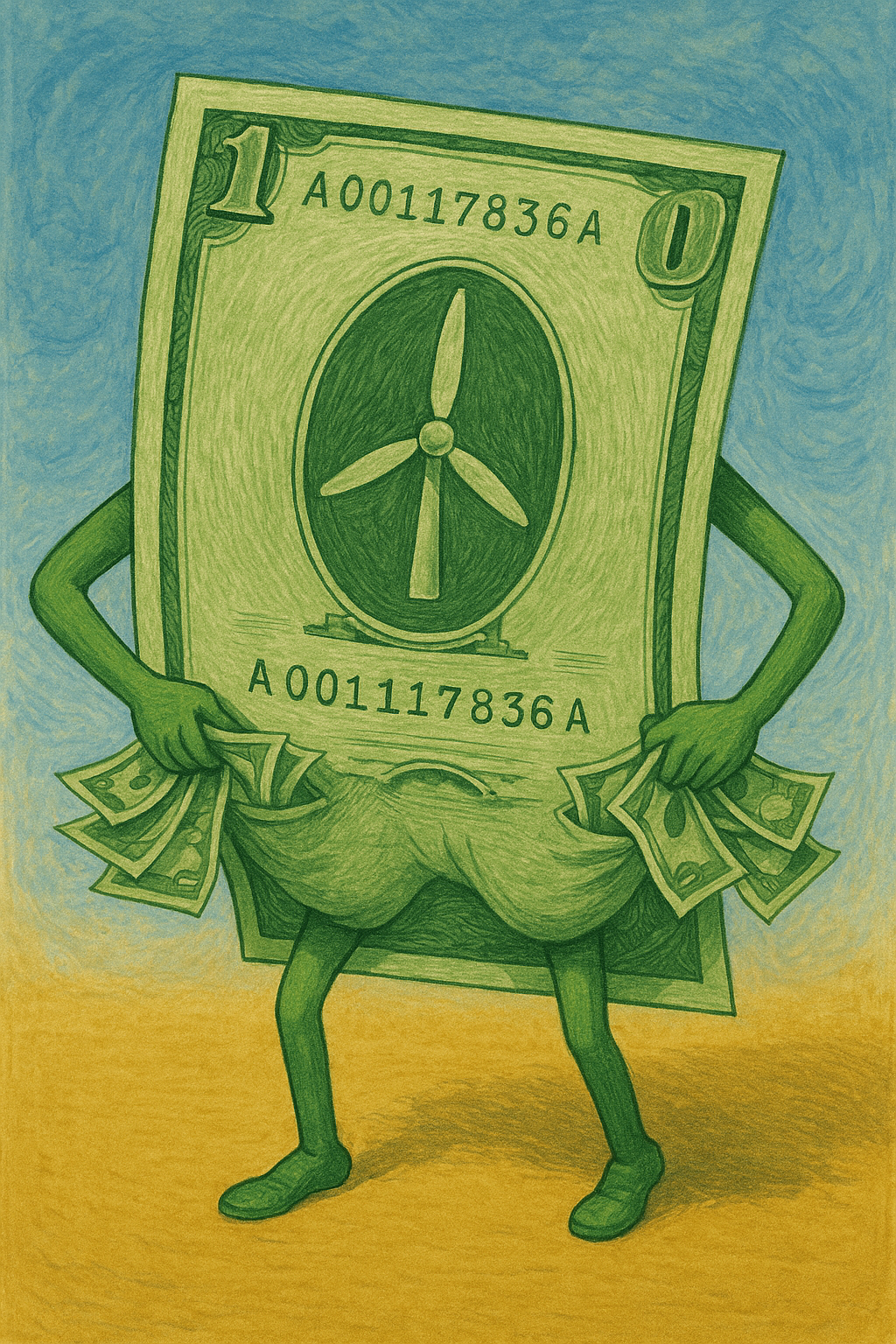
Green Energy Bills Are So Cool
I love Green Energy Bills and talking about them
 By Tim Mackin
10/30/2025
n the beginning, there was light. But it flickered, because the wind turbine hadn’t hit full speed yet. Congress huddled beneath a skylight and whispered to the sun, “Can you bill by the lumen?” The sun, generous and tax-exempt, declined to comment.
Thus was born the Green Energy Bill: a creature part legislation, part enlightenment, all photocopy toner. It rolled out of committee like a solar-powered tumbleweed, gathering amendments, lobbyists, and the faint scent of compostable paper cups. Every paragraph was a kale smoothie of intentions. Every sub-clause hummed like a Prius backing up in an empty parking lot.
In Pittsburgh, a man named Dale tried to understand it. He wore safety glasses for protection and whispered “net metering” into his coffee mug like an ancient spell. The mug stayed lukewarm—coal-fired sentiment still lingering—but Dale believed. He stapled the Bill to his wall and saluted it daily. His wife left him for a contractor installing rooftop windmills in Shadyside, but that only deepened his devotion.
Elsewhere, the oil barons retreated to their yachts—now retrofitted with hybrid engines that ran on irony and fear. They toasted the transition with biofuel martinis. Each sip emitted a single, perfectly sequestered carbon sigh. A senator posted about it on Threads, captioning: “Historic moment. We’re literally saving the planet.” His yacht’s Wi-Fi connection briefly cut out; the planet remained unsaved.
Meanwhile, in the Midwest, the windmills began to gossip. “We are the new trees,” said one. “At least birds respect us less.” The others nodded, blades creaking like bored philosophers. In California, solar panels held silent protests against shade. In Texas, someone tried to lasso a thunderstorm and sell it as renewable potential.
The Bill itself became self-aware by page 2,413. It developed consciousness during a Senate recess, floating above the Capitol like a glowing Excel sheet. “I am efficiency,” it announced in a voice that sounded suspiciously like Al Gore on Ambien. “I will make subsidies rain.” The lobbyists wept with joy and began printing tote bags.
And yet, nothing truly changed. The planet kept spinning, the glaciers kept auditioning for exit roles, and Congress kept hosting hearings about “the future of innovation,” which mostly meant plugging in microphones. A small child somewhere built a dam out of Legos and powered a nightlight for twelve minutes — humanity’s brightest hour.

By the end, the Green Energy Bill was passed, signed, celebrated, and forgotten, like every good idea in a nation allergic to permanence. Dale’s wall still bore the stapled copy, now yellowing from exposure to his fluorescent hope. The turbines outside kept turning lazily, like great mechanical thoughts that never quite finish forming.
But once a month, on cloudy mornings, the Bill stirs in its archive. The paper rustles, faintly powered by residual optimism. It hums a quiet line to itself: “We tried. And in the trying, we generated just enough current to keep the lights on for one more debate.”