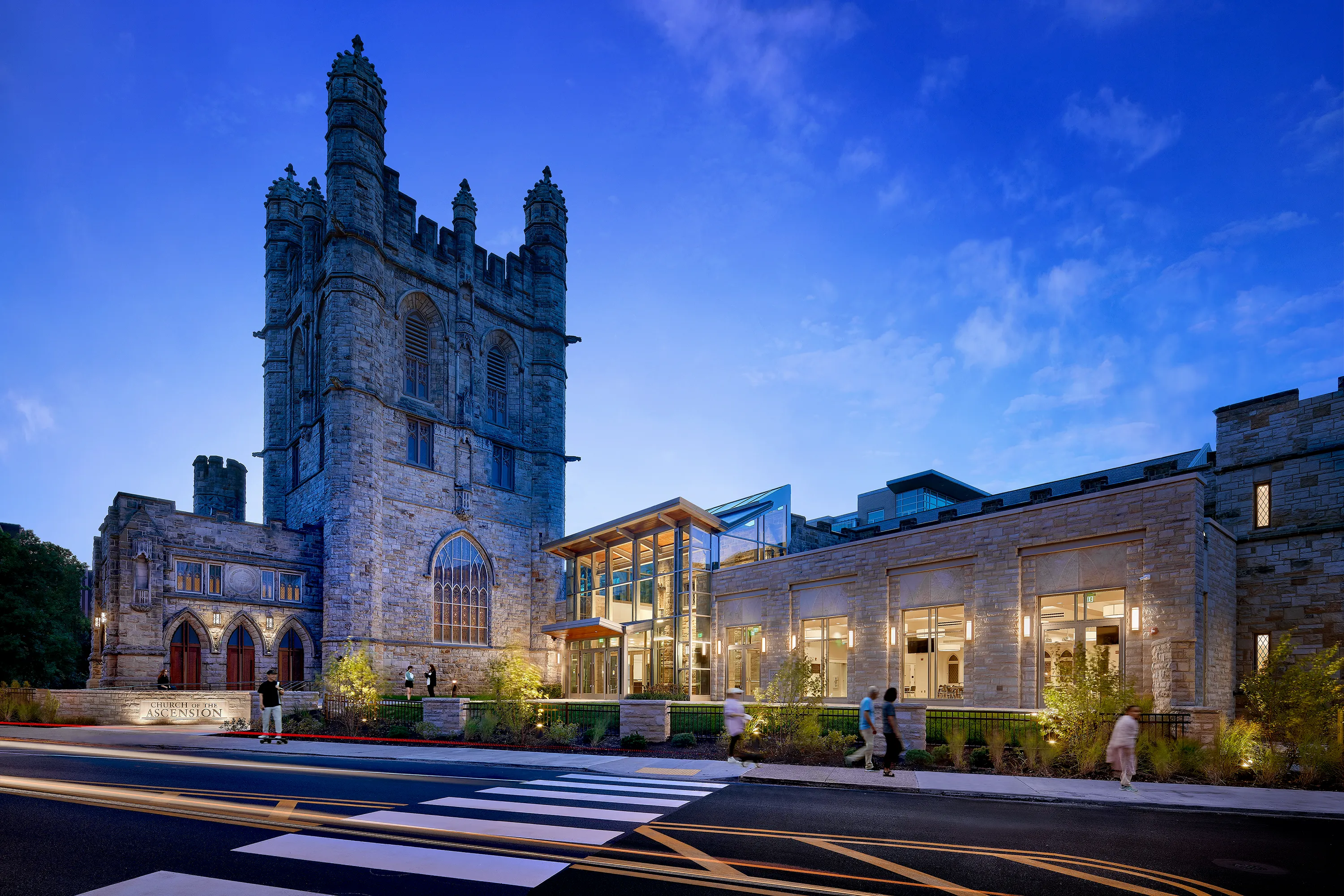
The Church of the Ascension has served Shadyside’s Episcopal community since 1887. Originally a small wooden chapel at the corner of Ellsworth and Neville, the rapid migration of Pittsburgh’s wealthier families into the East End during the late 19th century enabled a swift upgrade in both size and scope.
Designed by famed architect William Halsey Wood, known for his dramatic and deeply expressive Gothic Revival designs, a commanding new stone church was erected in 1898. Its muscular form and handcrafted detailing gave off the aura of a medieval Christian stronghold transplanted into the city’s emerging elite urban fabric.
A Parish Hall was added in 1910, and in this form, the church witnessed the rise of automobiles, multiple Pirate’s championships, a world war, a great depression, a second world war, steel’s peak and steel’s fall. In 1971, this outpost from another age was added to the List of Pittsburgh History and Landmarks Foundation’s Historic Landmarks and by the early 2000’s, generations of trial and blessing necessitated aesthetic and structural changes.
A hundred plus years of industrial soot had permeated into a significant portion of its façade, and a growing congregation with evolving tastes required more space and an updated look. This is when Jendoco Construction became the congregation’s long-term collaborative partner. The Pittsburgh based general contractor was hired to build an education wing onto the facility in 2001, and the relationship deepened further in 2008, when the Church decided to purify the exterior.
Because of the building’s age and historic import, this cleansing could not be done over the course of a few weekends by congregation volunteers wielding rented power-washers. It took years, and the Jendoco team worked closely with the church to map out, sample, and analyze the mortar of every single stone. They were able to utilize a high-resolution photographic survey of each block and work off that, providing the church with frequent status updates based on this hyper-specific data.
“We had such a great experience with them,” said Marilyn Chislaghi, the church’s director of ministry. “We were just really happy with their work.”
So, when it came time for the church’s most significant expansion since William Wood converted the chapel into a castle, the congregation did not run a competitive procurement process. They simply went back to Jendoco.
The congregation had three main problems and the first was logistical. The church’s three buildings; the nave, the parish hall, and the education wing, all connected via a narrow, outdated hall called the ambulatory. Circulation here was so awkward and claustrophobic that the passage became known as “The Crush.”
The second was space. As attendance and ministries and services expanded, the church was running out of room. The parish hall was too small for larger gatherings. There were insufficient bathroom facilities. The second-floor offices had become outdated, and safety features like a full sprinkler system needed to be added.
The final need was aesthetic.
“What the building was communicating about us was not what we felt about our church community,” said Chislaghi. “Namely, it looked like a fortress.”
Vibrant life-affirming activity and worship was hidden from the surrounding community by stone. That same exterior blocked light from entering the building, creating a medieval atmosphere inside portions of the building.
By late 2019, the group was ready to move forward and contacted Jendoco. The scope was intimidating: connecting three structures built a century apart on a tight urban site without disrupting services or disrespecting the beloved historical nature of the property.
For this, Jendoco needed a design partner they trusted as much as the church trusted them and so they turned to Rothschild Doyno Collaborative. The general contractor and architect firm have partnered on numerous projects in the past, including many on which the design and construction team was assembled before construction documents were completed.
Scott Koontz, Jendoco’s vice president of estimating and Melanie Buzgan Dower, principal at Rothschild Doyno, spearheaded the initial stages of preconstruction. Though the process sounded much like a design-build delivery, that was not the case.
“We each had a contract with the owner and Jendoco was the construction manager providing a guaranteed maximum price,” said Buzgan Dower. “We work most often in that realm of project delivery. It's helpful to have the construction manager on board early.”
Koontz notes that there are close working relationships between principals of both firms, although he and Buzgan Dower had never worked on a project together.
“It became about Mel and I trusting one another,” said Koontz. “When there was an issue, we learned to trust that we would come up with solutions that addressed her concerns and mine.”
For her part, Buzgan Dower says that she was able to successfully present design alternatives she knew would meet the owner’s needs.
“We had regular design meetings with the owner as we develop the design, and we invited the construction manager so that they could hear the purpose behind the design decisions we're making. There are social goals that we're trying to elevate. We know there are different physical ways to manifest those social goals that have different economic impacts,” she says. “In early steering committee meetings, Scott and [Jendoco President] Michael Kuhn were at the committee meetings with us. As we were presenting design options, they were able to provide cost feedback and insights that would allow us to stay in line with the budget. We found that approach to be successful on several projects, especially those that are nonprofits with committees as the decision-making body. It allows us to seek out meaningful design solutions that balance the economic with the social and physical.”
Koontz says the process acknowledged the difficulty of decision-making by committee by giving ownership more time to decide.
“We are far too often pushing people to make decisions before they're ready just to keep schedule moving, but as a team we mutually agreed right out of the gate that we would allow the ownership team time to reflect,” Koontz explains. “We allowed them to have a month after schematic design to chew on things because they're a committee. We did the same after design development. It took a little longer but, in the end, produced a beautiful project.”
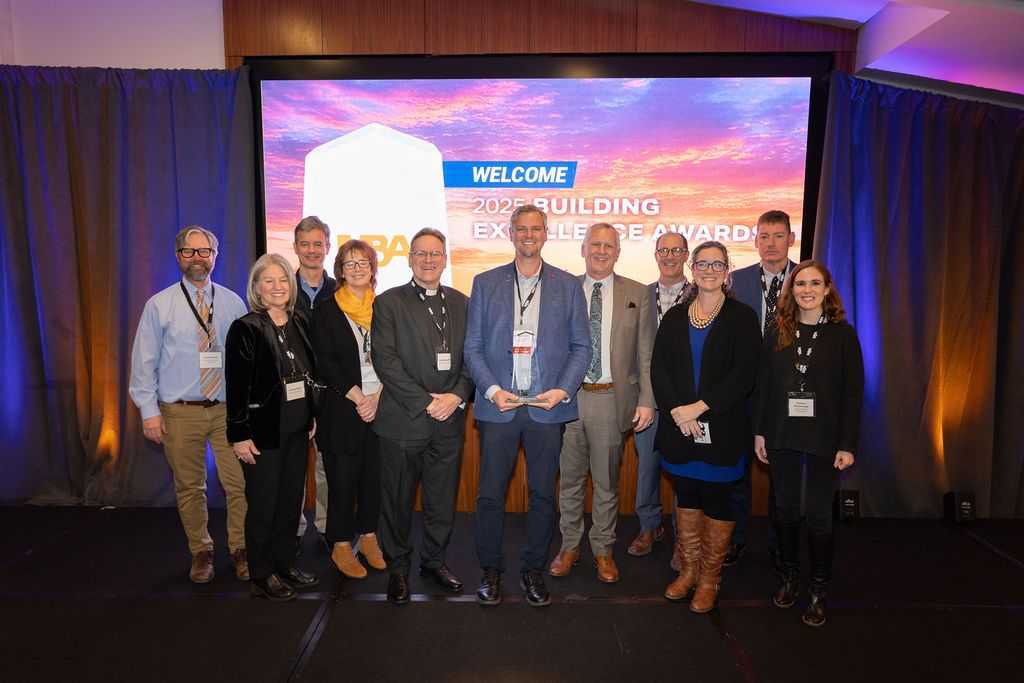
It's hard to deny that. The renovations have already won prestigious awards and are nominated for numerous others. Though the project contained numerous elements, the centerpiece was the creation of what the team dubbed “The New Narthex.”
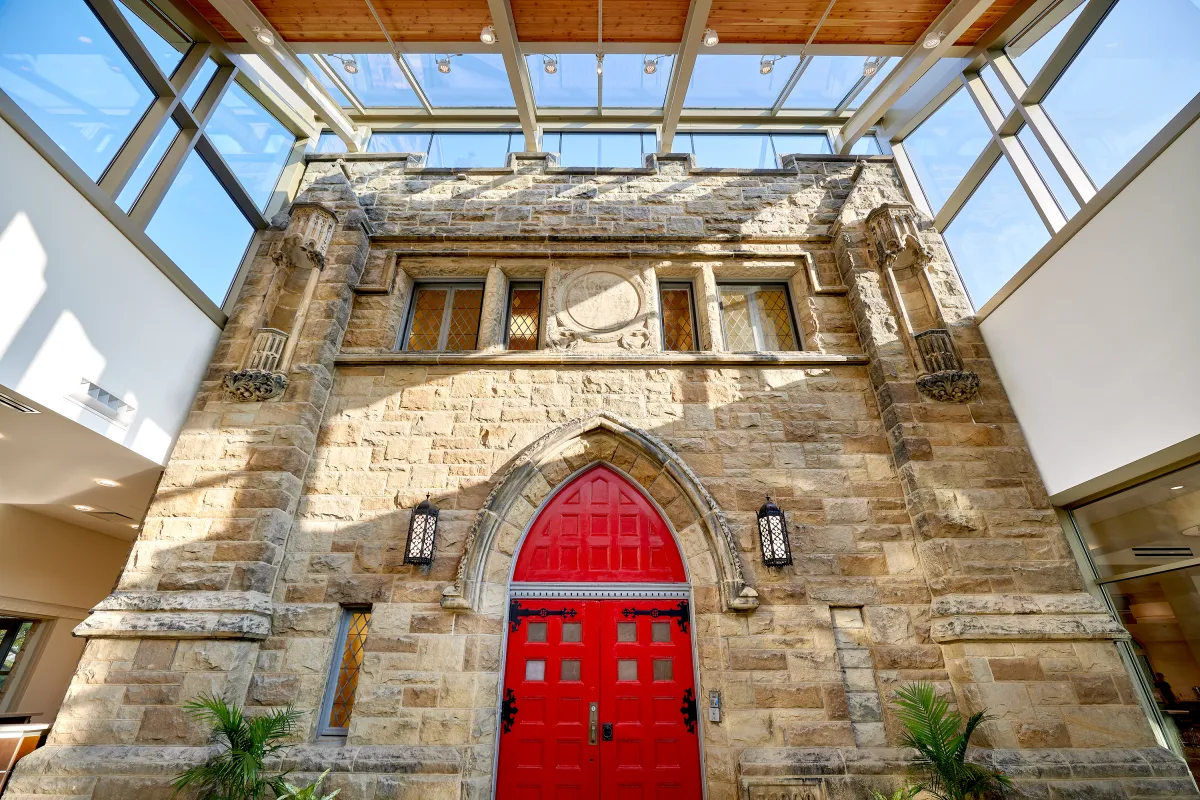
A narthex is a church’s entry space, the gateway between the fallen outside world and the inner sanctuary of the Almighty. Typical of older stone churches, the Ascension’s narthex was dark, enclosed, and inward facing.
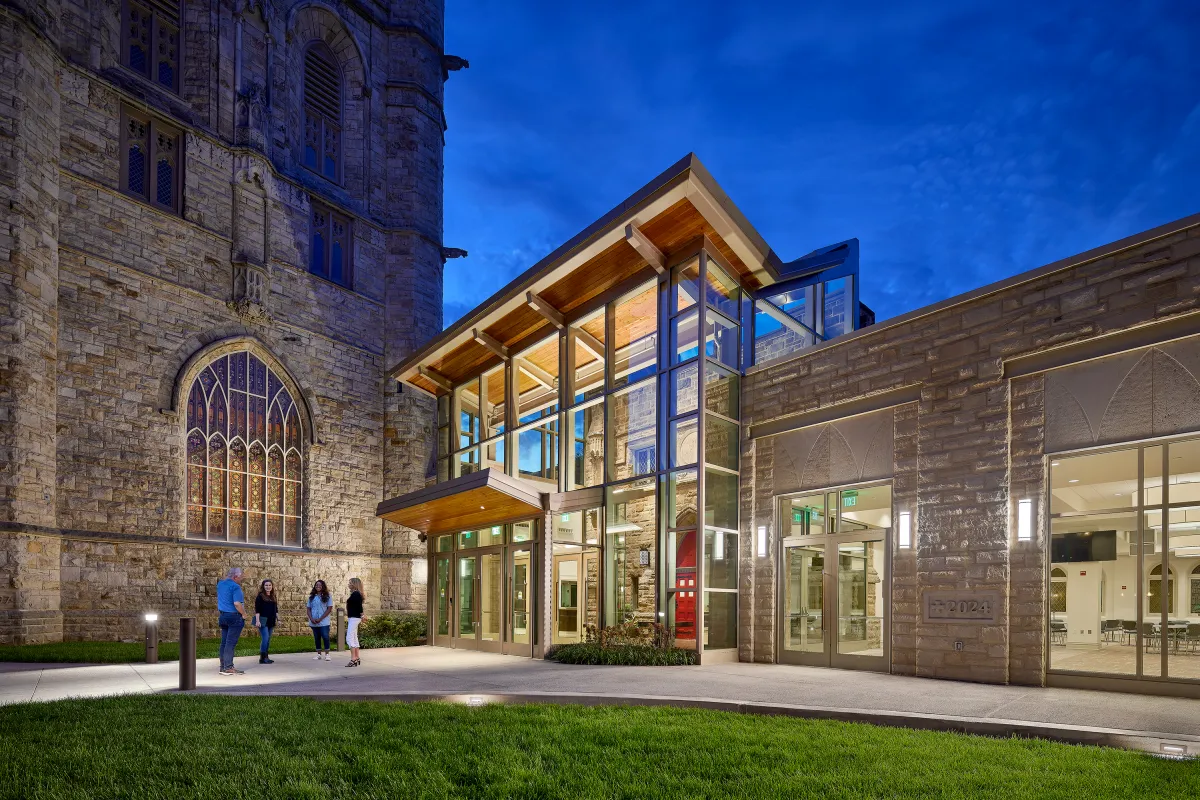
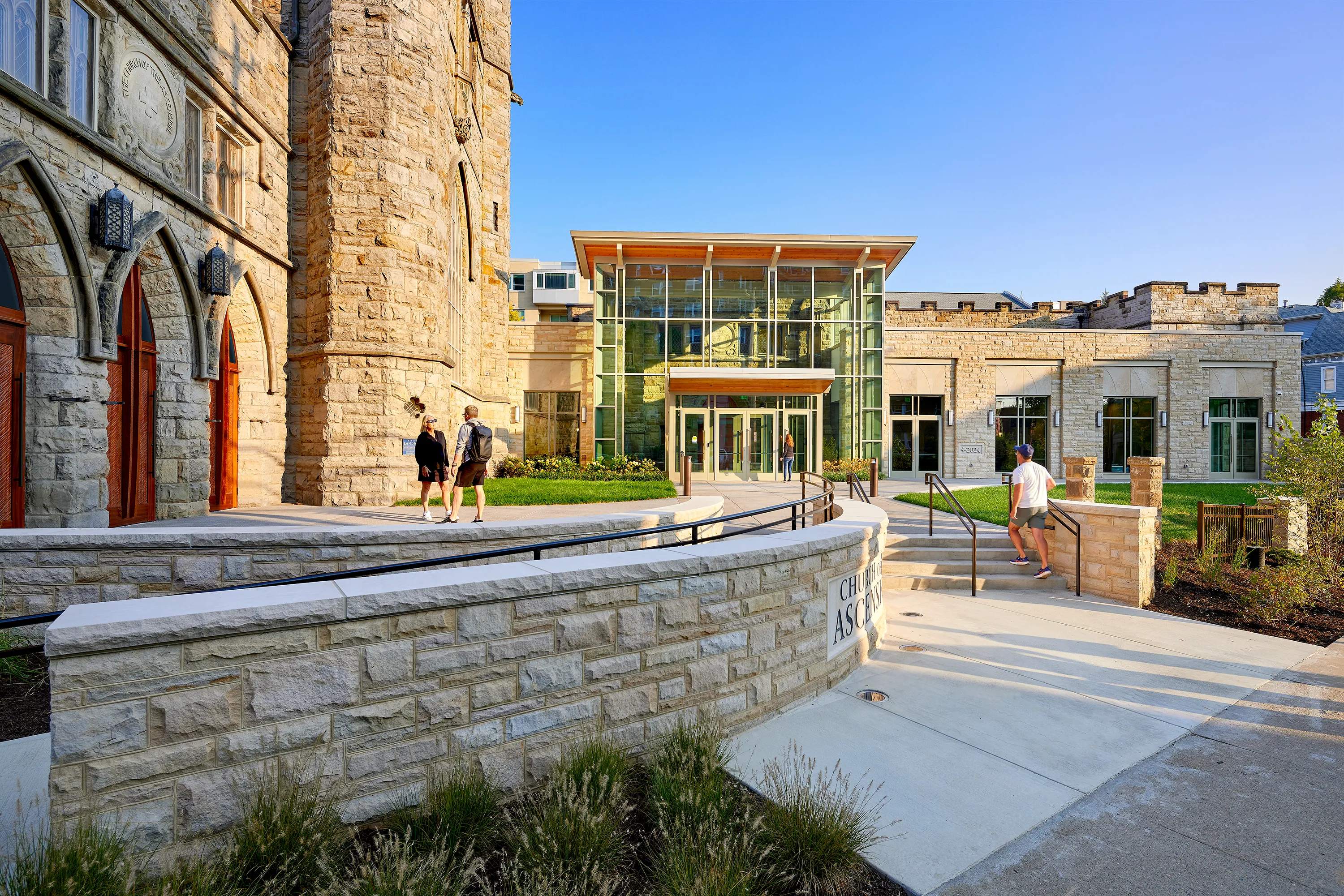
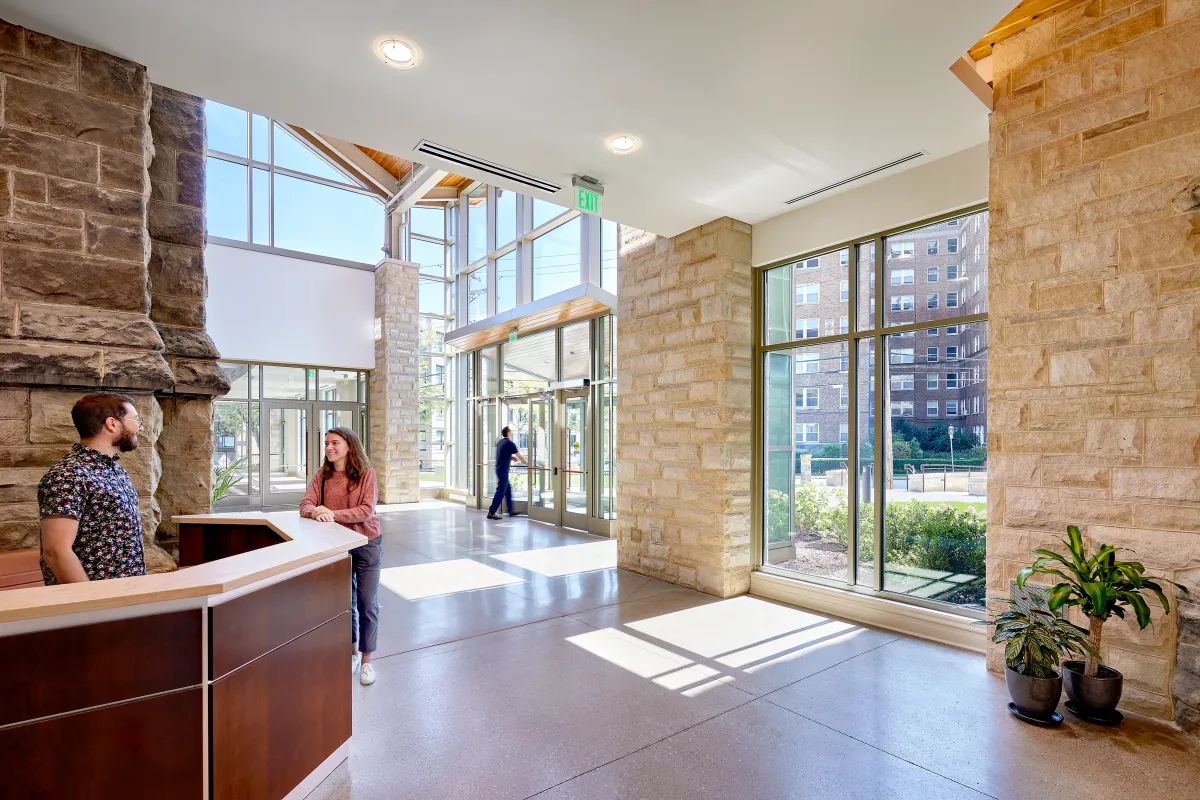
The new narthex replaced that with a two-story glass façade. Slim vertical mullions and broad glass panels that give the structure a sense of open weightlessness, visually dissolving the barrier between interior and exterior. An exposed wooden roof adds warmth and material contrast, making the addition feel crafted and inviting, rather than a purely modernist tack-on to a historic building.
The New Narthex also links the sanctuary to the parish hall and education wing, eliminating “The Crush” while creating a central gathering point and establishing a welcoming architectural identity visible to the surrounding community.
Significant unforeseen conditions also emerged during demolition and construction of the new narthex. The team discovered substantial deterioration in the Parish Hall’s wood-joist floor system, requiring shoring and partial reconstruction to safely connect the 1897 Nave, the 1910 Parish Hall, and the 1999 Education Wing. They also uncovered an undocumented underground electrical conduit bank that interfered with new foundation locations.
Perhaps the most complex and disruptive construction challenge came from the city water supply. Although early flow tests suggested a functioning 6-inch line on Ellsworth Avenue, exploration revealed three unexpected water lines, and the correct line was so clogged with mineral build-up that its interior diameter had shrunk to less than three inches, making it unusable for the fire sprinkler system. With work halted, the team partnered with Pittsburgh Water and Sewer Authority to pursue a rare and risky “live tap” into an adjacent 30-inch city main. After procuring specialty materials and developing a rigorous operations plan, the tap was successfully completed in June of 2024.
Another tricky renovation involved the doors. The original red wooden doors and the transoms above them were considered a trademark of the church, but they created architectural and experiential problems.
They were solid wood, blocking natural light. They also were not code compliant, creating potential safety issues. But replacing these was not a small choice. The red doors were central to the church’s identity and there was some controversy surrounding modernizing them. But ultimately the church decided that the building should feel more welcoming, the doors and transoms would have to be updated while remaining true to the original style.
Jendoco commissioned an artisan craftsman to hand build each component of the new doors. Every piece was shaped manually in a woodshop by a master craftsman and the door’s surface now features a distinctive hand carved texture, a rhythmic angled pattern that runs vertically, giving the doors a sense of movement and warmth against the heavy masonry. The solid wood transoms above the door were replaced with glass, revealing features that spent a century in the shadows.
“It transformed the room,” said Chislaghi. “That space has a beautiful ceiling and now it’s like…wow, we can see it.”
Given how the masonry was cut and the irregularity of the stone frames, installing the doors was a painstaking process.
“Michael’s team had to inscribe all of this wood into the shape of the stone and every perimeter in every one of those openings,” said Ken Doyno, president at Rothschild Doyno. “It was quite a task.”
All these complications were overshadowed and compounded by a far more serious one: The Coronavirus. The project’s earliest phases unfolded amidst the shutdown, creating unprecedented uncertainty around material pricing, supply chains, site access and the church’s ability to fund the work.
“I think our last service was March 8th,” said Chislaghi. “And of course, our fundraising campaign came to a crashing halt.”
Ascension depended entirely on its own capital campaign, which was achieved solely through its parishioners and donations. These same parishioners and donors were dealing with uncertainty about the future of their economic livelihoods.
That meant the design and construction teams had to build a plan flexible enough to grow or contract as the capital campaign evolved. With material prices fluctuating weekly, no one knew how much the congregation could realistically commit to.
To protect the church’s financial stability, the construction team crafted a system of alternate plans and “levers” that allowed leadership to scale scope in real time. Each week, Jendoco and Rothschild Doyno met with the parish to review exactly how much money had come in and what new components could responsibly be added. Some weeks, the scope expanded, other weeks, it tightened.
This high-trust transparent process was so strong that the church was comfortable moving forward with portions of the work even before the final fundraising total was known, at one point carrying an incomplete sketch directly into contract to just maintain momentum. Under normal circumstances, this would trigger a lengthy pause as architects redo drawings and contractors re estimate based on those drawings.
But that kind of time could drag expenses even higher, and instead of halting the process, Rothschild Doyno produced a quick conceptual “map sketch” that showed how the scope could be reduced while still preserving the project’s essential intent. Jendoco then translated that sketch into a corresponding cost strategy and presented it to church leadership. This required atypical trust and confidence among all parties, because the sketch was not a fully detailed design.
“We mutually agreed to drag some money back out of the site development package and carried that dollar amount and that simple sketch right into the contract,” said Michael Kuhn.
But despite the volatility of that terrible year, the parish ultimately raised enough to achieve every goal. The project that opened its doors was not a compromise, but a full vision, entirely funded by the congregation.
“It says something that I and Ken handled the construction administration. This wasn't the largest project that either one of us was working on, but it was certainly a special one that had its nuances and benefited from our direct engagement on a weekly or daily basis,” Kuhn notes.
“Ken passed the project on his way to work every day and often stopped by to meet with Rick Reinhardt [Jendoco’s superintendent] and talk through the challenges. Collaboration can be a buzzword but there is no other way to describe how we worked together. Ken and I have a great relationship, both professionally and personally, and that comes through in this project. It's trust, confidence, and a project-first attitude. Getting on the cover of Architectural Digest is great, but if the project doesn't serve the owner's purposes, and we can't build it within their budget, it's not so great.”
But perhaps the most telling quote about the level of collaboration came from Chislaghi herself, reflecting on the project’s end.
“It’s kind of funny. I looked forward to our meetings. When you finish a project, there’s typically a sigh of relief. This time, there was also this feeling of ‘I’m going to miss these guys.’”