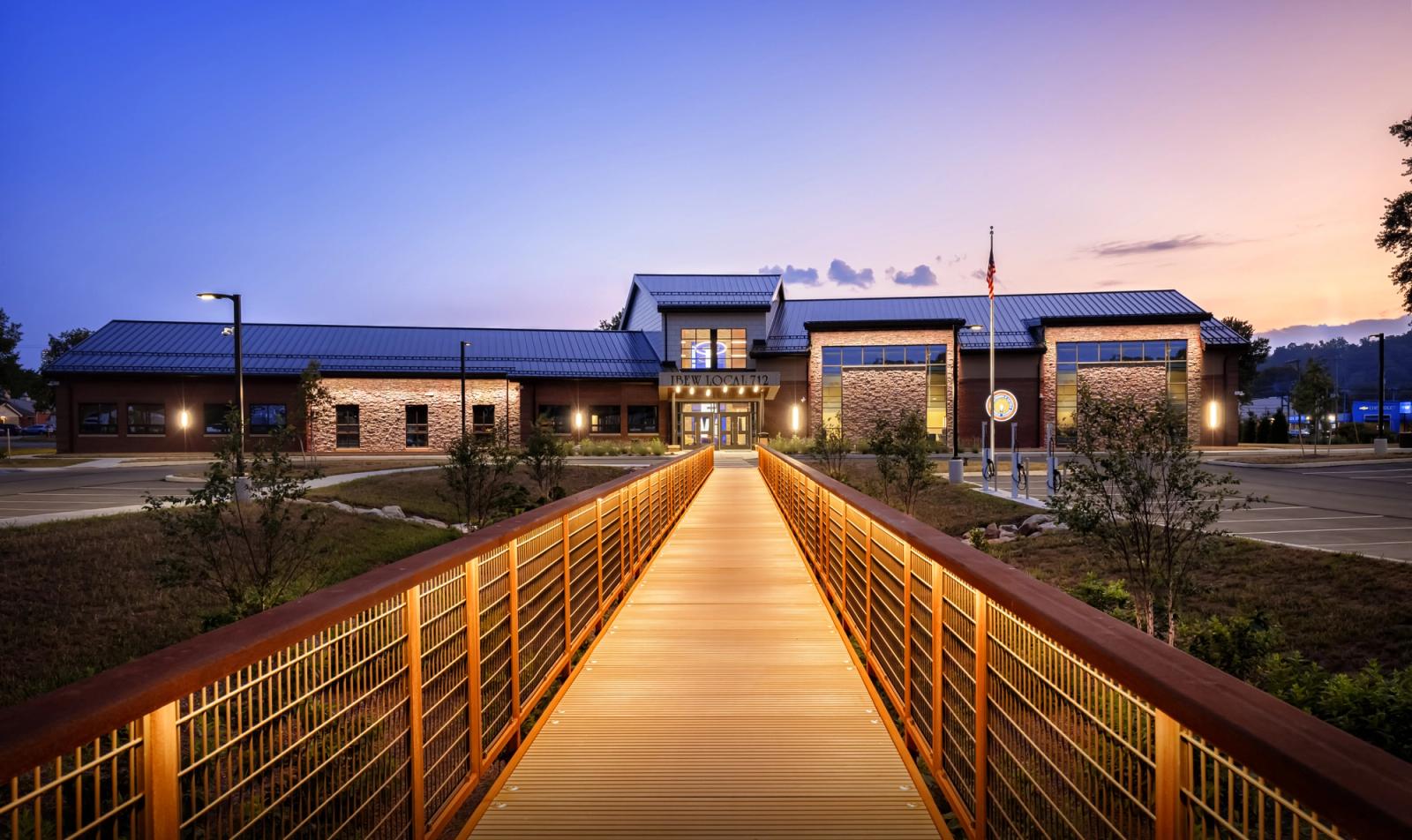
The IBEW Union Hall
 By Ben Atwood
3/6/2026
Construction of the new IBEW Local 712 Union Hall
didn’t begin with an empty site. It began in the middle
of a functioning one.
For more than a century, the International Brotherhood
of Electrical Workers Local 712 has trained and supplied skilled
electricians to contractors throughout Beaver, Crawford,
Lawrence, and Mercer counties. Founded in 1914, the union
represents more than 450 members whose work spans
residential, commercial, and industrial projects, supported
by a five-year apprenticeship program that combines handson
field experience with extensive classroom instruction
in everything from electrical theory and safety practices to
emerging technologies.
Its Union Hall and Training Center had been a cornerstone of the
Beaver community for generations, standing among the modest
homes and tree-lined streets of Sassafras Lane since the 1960’s.
But the needs of a modern electrical workforce had outgrown
the building’s capabilities and replacing it would require an
unusual level of precision.
Following a master planning process in the late 2010s, Local
712 determined to first complete a new apprenticeship training
center in New Castle, allowing attention to turn fully to Beaver.
There, the new Union Hall would be built on the same site as its
predecessor, which had to remain operational while its successor
rose beside it. Utilities had to stay live. Members continued
passing through its doors. And the steady rhythm of life on
Sassafras Lane was not to be disturbed. Yet crews still had to
drill geothermal wells hundreds of feet into the earth, run new
service lines, and construct a 20,000-square-foot facility that
would ultimately take its place.
Completed in 2025, the two-story, 20,000 square-foot LEEDcertified
facility fully supports the IBEW’s daily operations while
showcasing the dedication to craft that forms the heart of the
organization. Constructed entirely by local union labor using
American-made materials, the new hall includes a 150-seat
membership space, offices, conference rooms, and communityaccessible
areas.
Priority one was fitting in.
“They didn’t want to see any mechanical units on the roof or have
to service units on a roof. They wanted the building to fit in with
the neighborhood,” said Tricia Monaco, an architect at DRAW
Collective. Making that happen required careful coordination
between Monaco and her partner, senior architectural designer
Randy Riggins.
“That was a design challenge to get that to come together”,
said Riggins.
“There was a lot of things mechanically that we had to work
around to make the building look as elaborate, as aesthetically
pleasing.”
Instead of presenting a single, uninterrupted façade capped by
a flat commercial parapet, the building is composed as a series
of distinct volumes, each defined by its own height and roofline.
Sloped standing seam metal roofs with measured overhangs
and varied elevations replace the typical flat edge, giving the
structure a profile more commonly associated with residential
architecture. Where equipment was unavoidable, such as limited
chiller units, it was screened and integrated into the roof form so
as not to be visible from the surrounding homes.
Priority two was minimizing the impact of construction and
demolition on the nearby families.
“We kept the time frames tight as far as what the noise ordinances
were and making sure that everyone was adhering to those,”
said John Pappas, president at Eckles Construction Services,
who served as the project’s construction manager.
“The contractors were all good at letting us know what they had
coming up so that we kept people in the community informed
on what was happening and what the next phase of things were
going to be.”
The community certainly had enough on its mind at the time. This
was a covid project, conceived pre-pandemic, disrupted by it,
then built through it. The last thing the teams wanted to do was
add stress to the neighborhood during an already chaotic time.
This care was reciprocated and appreciated by the residents.
“One of the guys next door would pretty much every day come
and have coffee with the crews on site,” laughed Pappas. “He’d
bring them over snacks and stuff like that throughout the day.”
Interestingly, all parties agreed that while the pandemic created
headaches, the business of construction had already adapted to
its peculiar constraints.
“There were definitely supply chain strains that were holding
things, but I think as contractors, it was just another footnote
to make the project challenging,” said Geoff Measel, project
manager at E&G Development, who served as the build’s
general contractor.
“The real strain was logistics and a tight space. It was a
sequencing nightmare. I don’t say nightmare lightly—but it was
one of the hardest parts of this job.
“We were maintaining utilities to the existing building while
running all the new systems to the new building. And some
of them were crossing over each other. You’re building a
full brand-new building, drilling geothermal wells, tying in
site utilities while at the same time keeping the old building
operational. We had to move them into the new building,
tear the old one down, and then finish the site work. That
coordination was extremely challenging.”
The complexity peaked underground. New utilities needed
routing while existing lines stayed operational. Some systems
crossed paths while others required temporary tie-ins before
permanent ones could be established. And the chaos didn’t
end when the new building was completed. Once occupants
transitioned into the new hall, the old building needed
demolishing, including a basement that left a gaping void in the
center of future parking. Temporary parking had to be created
and then final utilities tied in before grades could be reset. Only
then was the project stitched back together as if it had always
been a single cohesive plan.
Meanwhile, the building was designed from its inception to be
carbon neutral and incorporated 20 geothermal wells as the
backbone of its energy strategy. Each well extends roughly 400
to 500 feet below grade, grouped into circuits that connect back
to a central manifold inside the building.
Designing and installing the geothermal field required careful
coordination and engineering. Soil conditions were analyzed
to determine heat transfer capacity, which informed both the
depth and number of wells required. On the tight site, the
well field had to be carefully shoehorned into the overall site
plan and sequenced alongside the chaotic implementation of
utilities, building construction, and eventual demolition of the
existing structure.
Beyond geothermal, the building incorporates several
additional strategies to reduce environmental
impact and improve long-term performance.
Energy-efficient glazing was used in curtain wall
systems to minimize heat gain and loss, while all
lighting throughout the building is LED-based to
reduce electrical demand.
Site design also played a role in sustainability:
stormwater is captured and managed through an
integrated rainwater collection system that gathers
runoff from the parking areas and directs it into a
central feature element. Durable, low-maintenance
materials such as terrazzo flooring were selected
for longevity, reducing lifecycle replacement costs
and waste.
The final challenge was making the building reflect
the Union’s work in a visible and instructional way.
That directive shifted the architectural approach
from concealment to exposure, instead of hiding
infrastructure, the building would display it.
“We had never designed a building where they
really focused on all the mechanical,” said Monaco.
“Everything was going to exposed, the bones of the
building would be on display. So, this mechanical
space was a showpiece.”
That showpiece is on the ground floor, centered
beneath the towering IBEW lettering that anchors
the lobby, within a glass-enclosed electrical room
glowing from behind the stone-clad feature wall.
Inside is the building’s main electrical equipment.
Panels, conduit runs, and organized infrastructure
all had to be aesthetically organized.
Every conduit run had to be carefully routed,
every tray aligned, every junction placed with
intention. The team worked closely with the trades
to choreograph what would be seen and what
needed subtle concealment. A programmable LED
lighting saturates the space in a deep red, washing
evenly across the equipment and reflecting off the
glass to create a uniform glow whose color can be
changed for holidays and causes like Breast Cancer
Awareness month.
Lighting is the core identity of the building’s owner and occupant.
Tricia Monaco described it as central to the design process.
Temperature, intensity, and placement all influence how a space
feels, both inside and out.
“I personally feel that lighting really sells our spaces and our
designs, and lighting is actually the most important part of our
designs. We didn’t want you to really see the light, we wanted
it to glow.”
Rather than flooding the site with tall, high-intensity poles, fixtures
are spaced deliberately and kept at modest heights, providing
clear visibility without casting excessive glare. Landscape
elements reinforce this approach. Plantings, grade changes, and
the recessed drainage corridor create natural buffers absorbing
and softening light before it can travel outward.
In front of the building, an illuminated pedestrian bridge
becomes the primary visual feature, but even here the light is
contained within the railings and directed downward onto the
walking surface, allowing it to guide movement safely without
projecting brightness into the surrounding neighborhood.
On the building itself, illumination reveals form rather than
overwhelm it. Light is concentrated at entry points, beneath
overhangs, and within recessed façade elements, where it
highlights material texture and depth while remaining shielded
from direct view at a distance. Wall-mounted fixtures cast
controlled vertical washes that stop at the surface instead of
spilling outward, and interior light is moderated by the depth of
window openings and overhangs.
This attention to detail peaks in the lobby, where the lighting
is layered like a composition. A circular ring overhead sets the
tone. It’s scaled to the building’s height and reads as a band of
energy racing around the ceiling. The wood panel’s horizontal
reveals wash soft lighting across their surface creating rhythm
and shadow. But the real kicker comes from the floor. The
terrazzo doesn’t mirror; it diffuses. That ring becomes a softened
halo. The red glow of the exposed electric room reflects warmly
off the floor while the IBEW seal looks as if it’s rising from within
the surface.
The building itself pulls off the same quiet trick. In the end, the
IBEW Hall doesn’t resemble a commercial intrusion at all. It
sits comfortably on its lot like a neighborhood church, glowing
with the familiar aura of small-town life. Its broad roofline and
measured height align with the horizon of nearby homes,
keeping it in scale with brick houses, mature trees, and quiet
residential streets.
Just blocks from Main Street, within sight of the Ohio River
and the layered ridgelines beyond, the building feels rooted
in Beaver’s landscape. Lawns, sidewalks, and calm residential
blocks frame it on all sides, and the architecture responds with
restraint. It belongs to the trades that built it and equally to the
neighborhood that lives beside it.