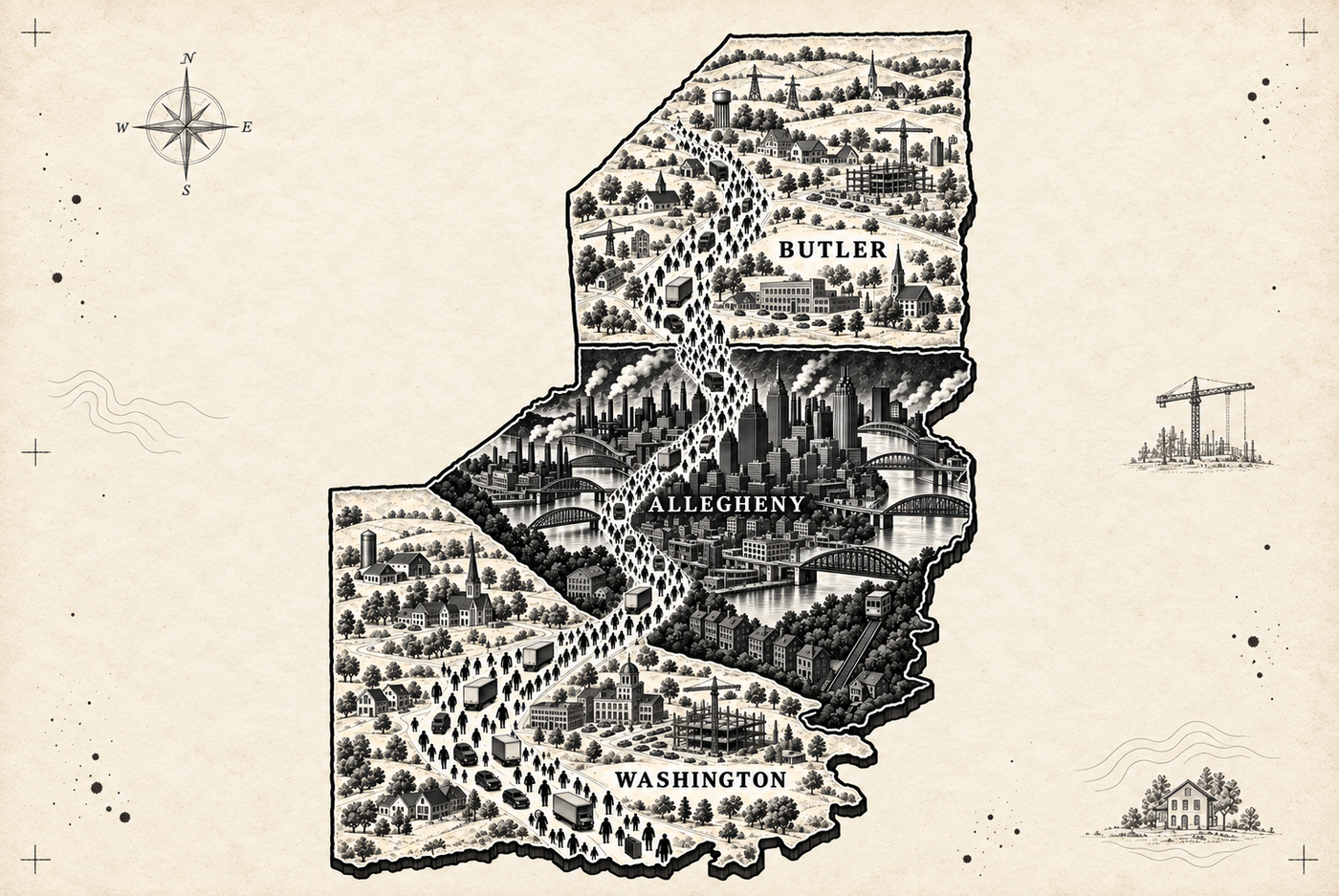
For hundreds of thousands, there was little incentive to stay in the area. As unemployment skyrocketed and communities deteriorated, people left in droves. But this economic and demographic landslide triggered a massive internal migration that fundamentally reshaped the Pittsburgh MSA.
En masse, those who could began leaving steel towns and river communities for the newer suburbs bubbling up around I-79. This effect was quite pronounced north of the Allegheny River. Places like Aleppo, Sewickley Hills, and Franklin all experienced population growth over 100 percent since 1970. Pine, Marshall and Ohio all grew by over 200 percent in that same time.
As this corridor developed, growth poured into Butler County, largely flowing into Cranberry, Adams and Jackson. A positive feedback loop was kickstarted by the negative one steel had created: new residents brought money, money brought amenities and jobs, and the live/play eventually brought big employers. Over the decades, what had once been a rural fringe became arguably Western Pennsylvania’s most complete suburb.
This internal migration also occurred south of the Monongahela, but at much smaller scale. Town’s adjacent to I-79 like Upper St. Clair, South Fayette, North Fayette, Collier and Robinson all saw notable gains, but not nearly at the levels experienced in the north.
Instead, the highway’s real impact was in Washington County. Since 1950, Peters Township has grown by over 660 percent, the strongest levels of growth in Western Pennsylvania. North and South Strabane, South Franklin, Cecil, and Nottingham also experienced population growth near or over 100 percent in that same time.
As in Butler County, this triggered a surge of development. A major office park arrived near Canonsburg and new retail blossomed. But these optimistic numbers do not tell the full story of Washington, because while Butler turned its advantages into generations of uninterrupted countywide growth, Washington did not.
The county’s current population is about the same now as it was in 1950. That’s curious. Both counties benefited from the outward migration of people and development from Allegheny County. Both had access to I-79. Both had large amounts of undeveloped land within commuting distance of Pittsburgh.
Why has the population of one dramatically expanded over the past two generations, while the other remained essentially flat? The answer is multifaceted. One obvious reason might be the highways, that there is some inherent advantage Butler gained from being at the nexus of I-79 and I-80.
Another factor could be geological. Using elevation data to measure the slopes of the Allegheny Plateau across both counties shows Butler is markedly flatter, with a median slope of 9.8 percent compared with 16.1 percent in Washington. More than half of Butler County’s land has a grade below 10 percent, compared with just 23 percent of Washington County, while nearly three-quarters of Butler is below a 15 percent grade. Flatter terrain generally means fewer grading challenges, more usable acreage and lower costs for roads, utilities and large building sites.
Another big reason is likely historic. Back in the 50’s, Washington had nearly double Butler’s residents. There was simply more land to be built on. That population gap was largely due to the heavier levels of industrialization in Washington. The Monongahela shapes the county’s borders, which meant heavier concentrations of economic and demographic growth during the gilded age, but also that the economies of numerous townships were vulnerable in the great downturn.
So, unlike Butler, Washington lost residents during the 70’s and 80’s because places like Charleroi and Donora were hit hard by the decline of steel and coal. That left a legacy of brownfield sites and the deterioration of these townships and municipalities created capital roadblocks for development.
Essentially, Washington had an industrial hangover that Butler didn’t. Of the county’s 65 municipalities, 45 have experienced population declines since the 1970’s. Any coordinated recovery strategy had to deal with issues of blight and poverty that simply didn’t exist in places like Cranberry or Zelienople.
And finally, there was a difference in how the two counties prepared for the changing economy. While it is a noteworthy achievement that Washington staunched the demographic bleeding, local officials believe that Butler County was ready for the internal demographic reshuffling in a way Washington was not.
“Butler County basically did a better job reading the tea leaves,” said Nick Sherman, one of Washington County’s three County Commissioners.
“They looked at long-term comprehensive planning early and were ready when the dominos started falling.”
Sherman believes that historically, Washington county has allowed development to dictate infrastructure rather than using infrastructure to guide development. He says that its particularly apparent in housing, sewage and amenities like parks and recreation centers. Asked how Washington County competes against the North Hills for families and investment, Sherman was remarkably candid: “We’re getting our butt kicked.”
That assessment is striking because by several measure, Washington County operates from a position of considerable strength. Seasonally adjusted unemployment rate stood at 3.5 percent in June 2026, below Pennsylvania’s 4.1 percent, while per-capita personal income reached $76,764 in 2024, approximately nine percent above the statewide figure.
Washington also retains an unusually deep concentration of industries that build, manufacture, extract and maintain physical assets. Construction accounts for 8.1 percent of county employment compared with 4.5 percent statewide, while manufacturing employs nearly 9,800 people and represents a larger share of employment than it does across Pennsylvania. Energy is an even greater outlier. Mining, quarrying and oil and gas extraction account for 4.1 percent of Washington County employment compared with just 0.3 percent statewide, giving the sector a location quotient of 12.20.
And most importantly, its population is growing. Unlike Beaver or Westmoreland, Washington has demographically recovered from the economic impact of steel and is seeing modest levels of gains. But that growth masks a significant shift of Washington’s population composition.
Washington’s median age increased from 43.6 in 2010 to 44.5 in 2020, while the population aged 60 and older increased by 12 percent during that same time. Simultaneously, the number of residents between 40 and 49 declined by 18 percent, while the population between 10 and 19 fell by 15 percent.
So, unlike Butler, Washington isn’t attracting as many families willing to put down roots. This is a serious long-term risk, and why Sherman is so focused on the issue. Without a sustained influx of new residents, Washington will become older, with fewer working residents and children supporting a growing elderly population.
As that larger, older generation leaves the workforce, a smaller generation is moving up behind it to replace those workers, taxpayers and households. Without enough younger residents moving into the county, that imbalance compounds: fewer young adults mean fewer families and children, which eventually produces an even smaller working-age generation.
Fewer workers create problems for local employers and severely hamper attracting outside businesses. Fewer taxpayers means less money for supporting roads, schools, and municipal services. As those pressures accumulate, communities have fewer resources to invest in themselves, making it even harder to attract the next generation of residents and businesses.
The numbers illustrate the risk. The Pennsylvania State Data Center projects Washington County’s population will fall from about 209,000 in 2020 to 188,354 by 2050. This is a loss of roughly 21,000 residents, or 10 percent, in just three decades. That would erase essentially all of the population Washington has regained since the steel collapse and leave the county with its smallest population in generations.
County officials are well aware of this and outlined a new recovery plan in their 2023 comprehensive plan. This establishes a ten-year strategy for attracting and then managing growth and development. At its center is an effort to move away from scattered, opportunistic projects toward what the county calls a “targeted development/redevelopment growth strategy.”
Washington officials want to concentrate public and private investment in places where transportation, utilities and other infrastructure can support it, while preserving agricultural and rural areas where additional development makes less sense. Aging water and sewer systems and gaps in service can make proceeding on otherwise developable properties too difficult and expensive.
“We’ve met with D.R. Horton and Ryan homes,” Sherman said. “And they’re like, ‘Listen, wherever you put sewage in this county, there will be homes popping up right away.”
The county is seeking more direct financing mechanisms to accomplish that. The plan recommends investigating the creation of a Washington County Infrastructure Bank that could provide low-interest or gap financing for major municipal infrastructure projects. Potential funding sources include Act 13 impact fees, gaming revenue, liquid fuels funds, PENNVEST, bank financing and bond proceeds.
Sherman points to the new $40 million public safety building and the redevelopment of the former Washington Mall as great examples of public/private partnership, with the county helping fund demolition to make the numbers pencil for developers.
The Washington Mall redevelopment illustrates that strategy particularly well: the county funded demolition of the obsolete mall, removing a major obstacle to private redevelopment and creating a more family focused region while bringing in an employer who can provide highly competitive wages for blue-collar and retail workers.
In effect, Washington and its political leadership are seeking to create a revolving source of capital that could help move infrastructure projects forward when traditional funding falls short. The plan also identifies a mismatch between some of Washington County’s existing commercial real estate and where officials see future demand: manufacturing.
The Trump administration is highly focused on reshoring manufacturing and passed a remarkable set of tax incentives to encourage it. This could benefit a myriad of industries, but the major need right now is for data centers. Manufacturing the equipment used by and for the development of these facilities could expand rapidly as they begin to pop up across the region.
And there is some data to suggest an uptick in manufacturing activity locally because of it. EOS Energy, U.S. Steel, Lighthouse Electric, Mitsubishi Power, and GE Verona have all signed major leases in industrial properties over the past year. They all deal with power production or components needed to make hyperscaler data centers function. In fact, of the 15 deals larger than 100,000 square feet that were signed since the end of 2024, 11 were for companies producing energy and construction equipment that will likely be needed by the data centers.
Lighthouse Electric is expanding its Washington County manufacturing footprint with a new fabrication and kitting operation at the former Brockway Glass property in Canton Township. The Washington County-based electrical contractor moved into a newly constructed 100,000-square-foot facility along Interstate 70, with another 65,000-square-foot expansion already underway.
Lighthouse, which employs approximately 1,000 people, expects employment at the plant to increase from roughly 50 workers to 75 in the near term. The company is also investing approximately $15.4 million in equipment and improvements as it expands its off-site fabrication capabilities, including work serving artificial intelligence, data centers and other power-intensive projects throughout Appalachia.
The location is nearly as significant as the expansion itself. The former Brockway Glass plant had sat vacant for years before the Redevelopment Authority of the County of Washington acquired the property, completed environmental testing and remediation, demolished the former factory and constructed infrastructure necessary to prepare the site for redevelopment.
The work relied on Washington County’s brownfield program and Local Share Account funding, along with Pennsylvania’s Redevelopment Assistance Capital Program and Business in Our Sites program. Once the public redevelopment work was completed, Crossgates Management took on the private development risk, constructing the new facility and leasing it to Lighthouse.
Lighthouse may not be finished. Company officials are considering relocating its headquarters from Southpointe and additional fabrication and assembly operations into the former Ross Mould complex in downtown Washington, a project that could ultimately bring several hundred employees downtown.
Pennsylvania is supporting the expansion with at least $6 million in RACP and workforce-training assistance. In May 2025, the Shapiro administration announced a $250,000 planning grant intended to begin transforming a former coal mining site in Washington County into a shovel-ready industrial development. The grant went to the Mon Valley Alliance through the first round of Pennsylvania’s new PA SITES program, which was created to help communities prepare large development sites capable of competing for major industrial investment.
The Mon Valley Alliance will use the money to conduct a feasibility study for a 542-acre property along the Mon-Fayette Expressway. The site sits above former mining operations, meaning the immediate objective is not construction of an industrial park but determining whether and how the property can realistically be prepared for development. The study represents an early step toward converting the former mining property into a site capable of accommodating future industrial users.
State officials framed the project as both a brownfield-redevelopment effort and an economic-development opportunity. The grant also places the Washington County project within a much larger statewide site-development initiative.
For Washington County, the significance is less the $250,000 grant itself than what it could initiate. The county’s Comprehensive Plan had already identified the need for large, pad-ready industrial properties located along major transportation corridors. Two years later, the state was funding the preliminary work necessary to determine whether another 542 acres along the Mon-Fayette Expressway could be converted into exactly that kind of industrial inventory.
Sherman views himself as a new guard in Washington county politics, taking a more activist approach to getting funding for the region.
“I inject myself (into Harrisburg) whether you want me there or not,” said Sherman. “I’m going to be there,” he said laughing. “I’m not here to make friends, I want our piece of the pie.”
Sherman considers one of his jobs to be aggressively competing for state and federal money that he believes Washington County historically failed to capture. Rather than waiting for opportunities to reach the county, he said he and Commissioner Electra Janis regularly travel to Harrisburg and D.C. to pursue funding themselves.
Securing funding is one part of the challenge. Another, more intractable, might be bureaucracy. What frustrates State Senator Camera Bartolotta is that Washington County has many of the ingredients needed for substantial economic growth already in place, but those advantages have not translated into investment as quickly as she believes they should.
“We should see industry and manufacturing tripping over itself, rushing to Washington County to utilize this great resource (natural gas) to make their energy costs a fraction of what they could be elsewhere,” she said.
In her view, Pennsylvania's permitting environment has historically been one of the principal obstacles. Bartolotta gave great kudos to Jessica Shirley, the current Secretary of The Department of Environmental Protection, for improving the process, but described the underlying problem as a longstanding bureaucratic culture.
“She’s trying to work with a culture of this permitting constipation that we’ve suffered through for years and years,” Bartolotta said.
The Trump administration is extremely open about their desire to see more fossil fuel extraction, and Washington sits on an oceanic reservoir. The national energy market is already showing signs of acceleration. U.S. marketed natural-gas production reached a record 118.5 billion cubic feet per day in 2025, up 5.3 Bcf per day from the previous year, before climbing another 4 percent during the first half of 2026 to 121.3 Bcf per day. June 2026 production was 4.5 percent higher than a year earlier and reached the highest monthly daily rate recorded by the U.S. Energy Information Administration since its series began in 1973.
But Pennsylvania is not participating to the same degree, with statewide production increasing just 0.5 percent year-over-year during the first quarter of 2026, although drilling activity has begun to tick upward: 101 new unconventional wells were dug during the quarter, seven more than during the same period in 2025.
She believes Pennsylvania should find ways to process permits concurrently, prepare sites in advance and otherwise shorten development timelines without weakening environmental standards. The stakes, she said, are increasingly visible across state lines: “They are using our resource to win the race, when we should be doing it here, and we should be leading.”
Bartolotta believes Pennsylvania can aggressively develop its natural gas resources while maintaining strong environmental protections, rejecting the idea that the two goals are inherently incompatible.
“Two things can happen at once,” Bartolotta said. “You can be incredibly pro-energy... and the other thing you can do is make sure you’re extremely mindful, demand the highest regulations, and the best possible outcome for our communities.”
For Southwestern Pennsylvania, she sees the alternative as watching investment migrate elsewhere despite the region possessing the resource itself. But Bartolotta's vision for Washington County is not simply an energy story. Her argument is ultimately that industrial growth provides the economic foundation that allows that pattern to continue: good jobs give younger residents a reason to stay, return, buy homes and raise families in the communities where they grew up.
But energy has and likely always will play an outsized role in the local economy. It is a main reason why there’s a white-collar element to Washington as well. The Southpointe Park contains roughly 51 properties and is the heart of the county’s corporate employment, which is a major driver of population growth.
But the office market has recently undergone a major shift, thanks to the pandemic. Kelley Heckathorne of NAI Burns Scalo Real Estate, one of the major brokers involved in leasing up numerous properties throughout the park, estimates its vacancy was approximately 16 percent at the beginning of the summer, up from roughly 14 percent in 2025 and 10 percent in 2024.
Those numbers, however, don’t tell the full story.
“We’re still very busy,” Heckathorne said. “Within the past couple months, I completed six new leases, and I have two more out for signature. Four of the six relocated from outside the park. There’s always a lot going on here.”
More important than the vacancy snapshot for a rapidly evolving sector of commercial real estate is that tenants aren’t abandoning the park and relocations are occurring. Heckathorne says that many are just right-sizing for their post-pandemic needs, something that is happening globally.
Additionally, recent leasing activity is coming from a surprisingly diverse group of businesses and places. Heckathorne pointed to two engineering firms currently expanding within Southpointe, a software engineering company that relocated from Parkway West into approximately 8,000 square feet, an HVAC company relocated from Lawrence taking 16,000 square feet, GBU relocating from Pleasant Hills into roughly 32,000 square feet and a Peters Township law firm that doubled in size before moving into the park. Another financial company is working on an approximately 9,000-square-foot expansion.
Health care may soon provide a significant source of white-collar momentum. WVU Medicine has taken approximately 92,000 square feet near the entrance to Southpointe, while Allegheny Health Network has acquired land for a major new facility that Heckathorne said will include a hospital and physician offices. Those investments are already attracting interest from additional medical users.
If the county manages to expand white collar employment, it could be a real boost for demographic gains. Census data shows that 47 percent of Washington County residents commute 25 minutes or more to work, likely heading into Allegheny’s denser employment nodes. But even more interestingly: census data also shows that 56.6 percent of Washington County jobs are held by people who do not live in Washington County.
That is a very deep pool of people who have an existing economic relationship with the county. A major hurdle in converting them is that they might not have a place to live. CoStar shows that Washington County has about 120 market rate multifamily properties containing over five units and only seven that contain over 150 units.
Of these seven, five were built after 2010. Their aggregated vacancy rate is three percent, indicating that there is pent up demand for additional luxury communities. The most recent project, The Preserve at Peters Township, delivered in 2025. Rents for this community average about $1,929 and CoStar shows the 179-unit property is over 75 percent leased.
This is remarkable speed for the entire region, made even more so by the price point. This also lends credence to the notion that pent up demand exists for living in Washington, and why the county plan is hyper focused on connecting utilities like sewer for residential developers.
And that demand could be amplified further by existing and upcoming struggles within Allegheny.
Allegheny County was, easily, the hardest hit by the decline of steel. The number of people it lost since 1970 is more than all the other counties combined. Allegheny’s population has since stabilized, but its role as the economic engine of the region left it exposed to challenges that Washington and Butler do not have.
While Washington’s had a dozen or so steel towns along the river, Allegheny had scores. Just to maintain these locations requires enormous resources. These often soaks up money, which will become an even bigger problem in the coming years thanks to the office market reshuffle.
The downsizing that Southpointe experienced happened at a much larger scale in Allegheny, as downtown Pittsburgh offices experienced a sharp and noticeable decline in leasing activity and property occupancy. The property taxes paid by these offices were a major anchor in the city and county finances.
These properties are no longer worth as much and are being reassessed at a lower value. This reduces the amount of money going into the city and county coffers. These revenue pressures are arriving at an especially difficult time for Allegheny, which is also confronting a severely underfunded pension system. A county working group recently estimated that the system’s unfunded liability is roughly $1.4 billion and said addressing it could require approximately $100 million in additional annual contributions for the next two decades.
That money has to come from somewhere, and soon, or the county’s pension fund will face severe problems. County and city officials are openly discussing “painful choices” that will have to be made to maintain fiscal stability.
In 2025, the county increased its property-tax millage from 4.73 mills to 6.43, a jump of 36 percent. In August of this year, a court ordered a full countywide reassessment on property taxes, to replace the current 2012 base-year values.
This must begin by July of ’27 and be completed within five years. County Executive Sara Innamorato told the county council at a July meeting that there would be no tax increases in 2027, but it is difficult to believe that can last for much longer.
For Washington, what happens next door matters a great deal. For most of the past 70 years, the dominant demographic story of the Pittsburgh region has been people moving outward from Allegheny County. Butler County captured that movement better than anywhere else, transforming within generations.
Washington entered that period from almost the opposite position. Its larger population and heavier industrial development made the collapse of steel considerably more painful. But 50 years later, that old disadvantage looks different. Washington now has something it lacked when the regional reshuffling began: a substantial economic base of its own.
Washington's existing development is increasingly an asset. Southpointe is already a major employment center. Its energy industry is among the most concentrated in Pennsylvania. Manufacturing investment is arriving, health-care systems are expanding and more than half of the county's private primary jobs are already held by people who live somewhere else.
The county does not need to create an economic reason for people to come to Washington from scratch. Tens of thousands already do. The challenge is getting more of them to stay.
That makes the seemingly mundane questions surrounding sewers, water lines, housing and site preparation considerably more important. If Washington can use infrastructure to unlock residential development around the economic base it already possesses, it has an opportunity to turn workers into residents, residents into families and those families into the next generation of its workforce.
If it pulls that off, a positive feedback loop could result. More people, more income, more taxes, a higher standard of living, more demand. Rinse and repeat. Seventy years ago, Butler was prepared to capture a population on the move. Washington’s future may depend on whether it can now do the same.