Rolling Hills Aqua Park: Stare Into The Data Long Enough, And It Stares Back At You
Rolling Hills Aqua Park: Stare Into The Data Long Enough, And It Stares Back At You
There are many strange second-order impacts of having a baby. Some are lifestyle related: You become intimately familiar with 3AM, weekends are rendered meaningless, and 8:30 is now late night.
Bizarre new skills emerge from the ruins of your old life. You can pack a minivan with military precision, pour six ounces of milk with your eyes closed, and pick up a pacifier with your toes in the dark.
Entertainment also changes in unexpected ways. Football is out, Ms. Rachel is in. You have a favorite Frozen song, and playgrounds are suddenly central to your everyday life.
Parks, you whisper, are more important than you ever dreamed.
That last one’s real wild. You legit forgot these things existed 25 years ago, now you’re pulling recon missions across the south hills texting your wife updates on “the mulch situation” from the minivan.
Hays, Trotwood Hills, Morton Fields, Casey’s Clubhouse. You’ve got the pros and cons of each memorized. And while you don’t want to dog on anyone’s hard work, you frequently notice things about playgrounds that you don’t entirely care for.
The best ones are usually crammed, which means the play can be too rough for chunky little legs. They can also be surprisingly tall, with open platforms and climbing routes that pose real risk to an overconfident 22-month-old.
There have been a few close calls, so now, your head is always on a swivel. That sucks, and the shade options usually do too. Before the baby, you never really paid the sun any mind. These days, an escape from that celestial blowtorch is required before you even exit the vehicle.
Plus, slides get hot. Real hot. That painful memory bursts back into your consciousness shortly after you commenced advanced scouting operations. Others do too, which is actually the coolest second order effect of having a baby: you get to reexperience childhood through someone else’s eyes.
The feeling of flying on a swing, how interesting ants actually are, and the ecstasy that comes from getting wet. You’re reminded of that last one at one of these parks, when you notice something that you’ve never seen before: a large concrete pad where a few colorful pipes rise from the ground at odd angles and spray water everywhere.
This particular pad even has a button that your daughter can press which turns the fountains on and off. That makes her scream with laughter, which is just about the sweetest sound in the world. But it brings back zero memories.
These didn’t exist in 1989. Now you’re curious. So, you sneak out the phone and send a picture of it to the ChatGPT and ask what it is. The AI tells you that thing is called a “splash pad” and shows you a bunch of them in your area. Then it tells you that they’ve been growing in popularity with municipalities over the years because they’re far cheaper to maintain than pools.
You tell the machine you didn’t realize pools were expensive to maintain and it says: Oh yes. Surprisingly so. And it’s not the water maintenance, either. It’s labor. There’s a shortage of lifeguards because people are having less kids.
The agent now has your full attention. It’s not just lifeguards, it continues. Fewer children means more school consolidations, less retail, and fewer volunteer firefighters. That generally makes an area less desirable and keeps out people out. The second order effects of demographic decline, it says, can stack quickly.
You look up from the phone, and your daughter is licking a puddle on the concrete pad. Time to go. But on the drive home, you ponder on what the chatbot said. Seven of the ten years that you’ve lived in Pennsylvania were in small cities that have been losing people for decades. Pittston, Scranton, Washington.
These were all fine enough places when it was just you, but they were a little run down. Neighborhoods dotted with abandoned homes. Main streets half-filled with decaying storefronts. More police activity than you’d suspect for such a small place.
You would never move back to any of them with a child.
You glance in the rearview mirror at your now sleeping daughter and think about Scranton for the first time in years. These communities didn’t choose what happened to them. Their economies were simply second-order casualties of titanic market forces beyond anyone’s control.
They did everything society asked of them and still got run over. That sucks, too. At a stoplight, you tell the GPT your melancholy thoughts. Yes, it replies. Decline can be quite sudden, and kickstarting growth is incredibly difficult. You can’t manufacture 10,000 families by waving your hands. It takes decades of drudgework planning roads, schools, housing, and parks to build a reputation that draws families in.
A revelation washes over you. Parks, you whisper, are more important than you ever dreamed. Absolutely, the AI replies. And that’s what makes splash pads so interesting. There’s a new one in Peters Township. Massaro built it. That might make a good project profile for the September edition.
The word predictor is right. Attracting families to the region was the central theme of your feature piece, and it led you so far down a demographic rabbit hole that you were vibecoding 3D maps of Washington county’s demographic shifts, texting pics to your wife until she asked if you were unwell.
But you couldn’t stop. It turns out this entire region is in the midst of a great internal migration, a second-order impact of steel’s collapse. In the 70’s and 80’s, deindustrialization cut like a scythe over the rivers that were once the lifeblood of this region.
People left towns like Midland, Ambridge, and Charleroi in droves. Many left western Pennsylvania altogether. Everyone knows this.
Lesser known is that those who stayed (and could) increasingly went to the blossoming suburbs along I-79, effectively changing the entire market. And this migration is ongoing and because Western Pennsylvania is not bringing in many outsiders, it is producing clear demographic winners and losers.
Before you had even heard of splash pads, you noticed Peters Township was one of the biggest winners. In fact, among western Pennsylvania municipalities with at least 10,000 residents in 1970, Peters is the biggest winner.
That surprised you, even though you live five minutes from the town. Sometimes you take your daughter to the market district for donuts in the morning, but you’ve never actually gotten off Route 19. So, you tell the GPT to do a deep dive on the place and it pulls decades worth of Peters planning reports.
Central to them is sanitary infrastructure. Peters established its sanitary authority in 1964, and major sewer construction authorizations followed in the early 70’s. That timeline screams farm fields to sewer capacity to subdivisions, which is bananas, because when you interviewed a Washington County commissioner for the feature, he wouldn’t stop talking about the importance of sewers.
Schools were central, too. A new one seemed to pop up every few years, the most recent being a high school built on the same exact park where the splashpad you are thinking of profiling is.
This is too good to be true; you whisper to your little girl as you lay her in the crib.
The next morning, you reach out to the township to let them know you’ll be putting their splashpad on the map by describing its build in Western Pennsylvania’s premier construction trade magazine. A confused admin hands the phone off to a man named Paul Lauer, who is the town manager.
Paul has worked for Peters since 1984, when your mom was pushing you in swings. He tells you a plaque in the council chambers lists every town manager since the ‘60’s. Paul’s the third. He offers you a guided tour. Jackpot.
A few days later you’re meeting Paul and another man named David Brooks, who is the Peters Parks and Recreation Director. Both turn out to be thoroughly likeable dudes. They tell you that the township acquired the land in 2016, when it was a golf course called Rolling Hills.
They decided to cut it in half, using one side for the new high school and the other for a public park. Paul tells you that Peters residents are quite interested in park development. It is, he says: a top priority of the municipality.
He goes on to say that everyone thought that because this was a golf course, it would be easy to convert. But it didn’t turn out that way. It was quote: difficult beyond belief.
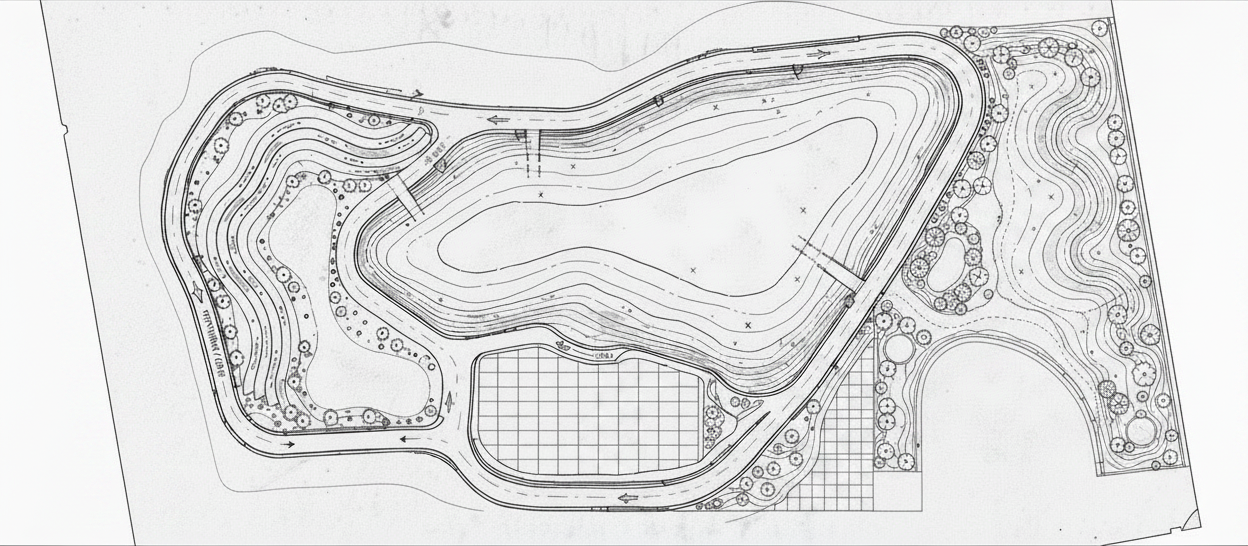
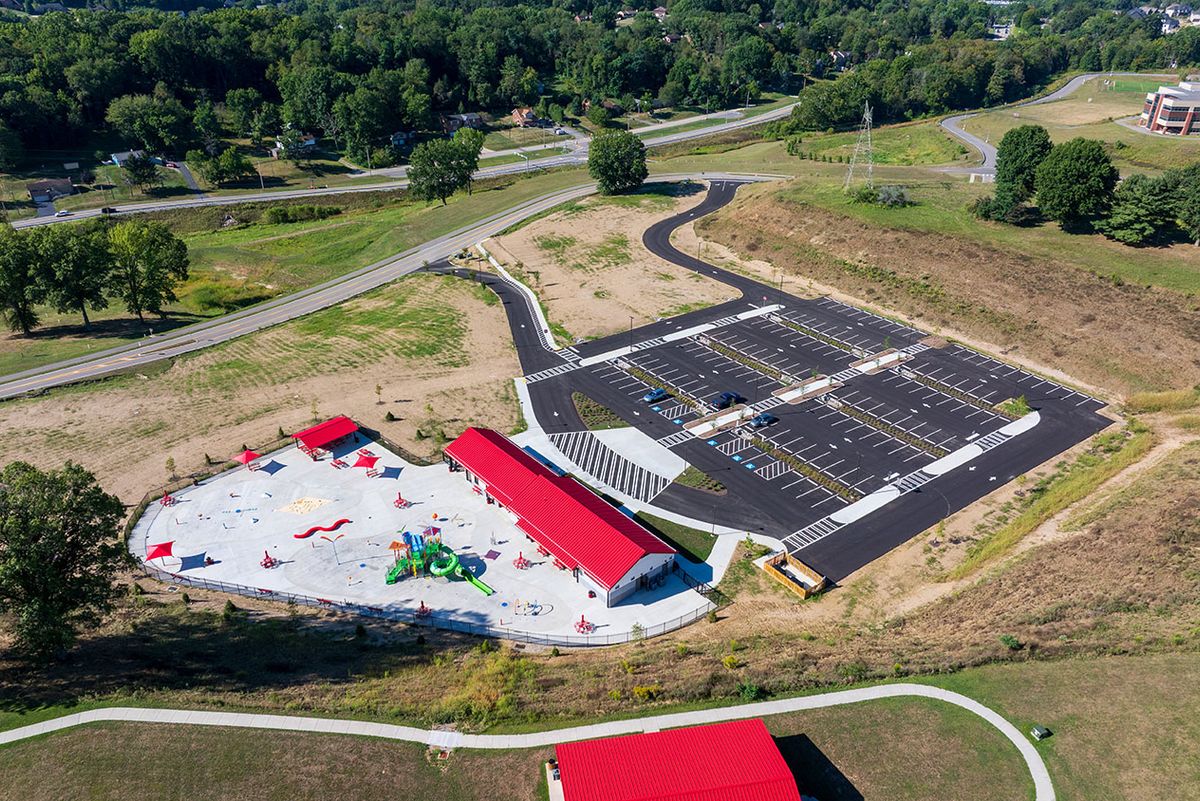
First, they built the high school, which really is quite nice. Then they cut a large looping road through the hills, tracing the cart path with the express purpose of creating a backbone from which the rest of the park could one day grow.
Photography by Kimmel Architecture and Rob Benton
While the earthmoving equipment was already there, they flattened a 2.5-acre piece of ground for the future build out of the splash pad. So, when construction began in early 2025, the heavy lifting was already done. Now, they could focus on design, safety and speed.
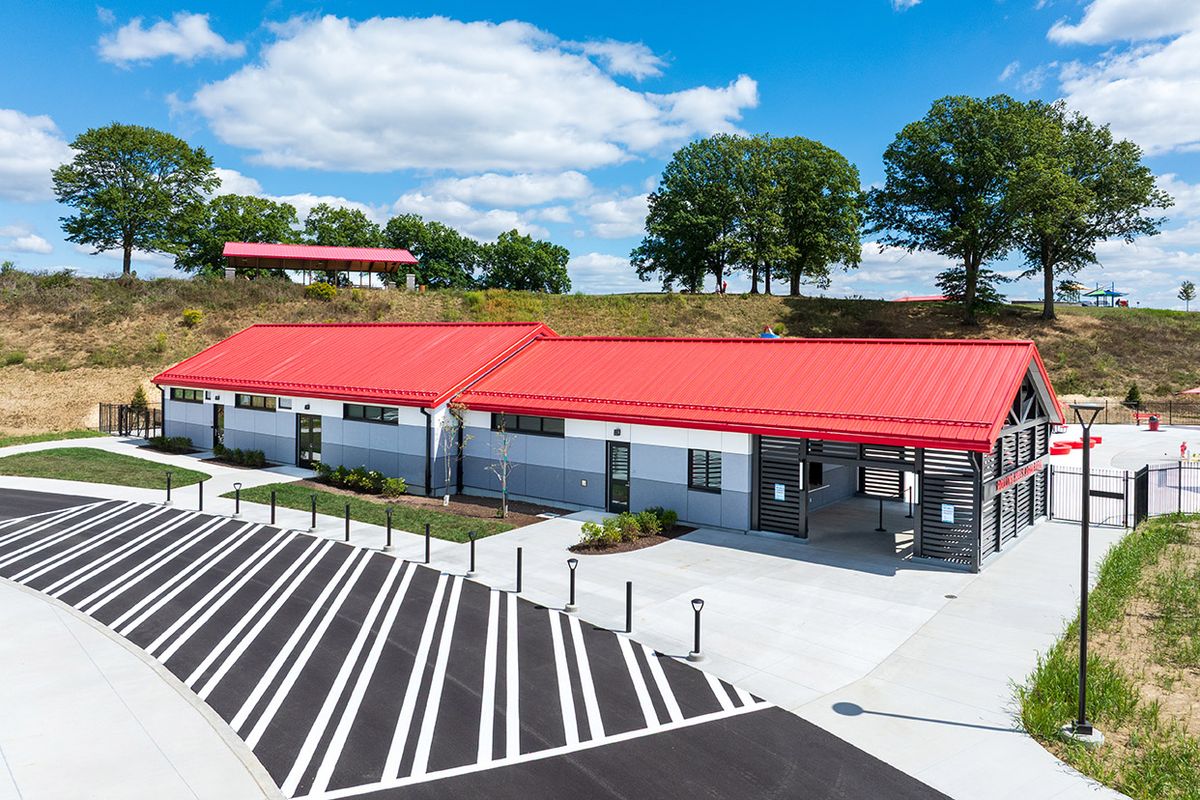
As you walk the site, you tell Paul and Dave that the building looks nice. You aren’t being polite, either. It’s surprisingly aesthetic for a small municipal facility. The long low frame settles naturally into the hillside, its strong horizontal lines echoing the broad contours of the surrounding terrain. A bright red standing-seam metal roof pops against sleek but monochrome gray fiber-cement panels, black accents, and slatted black façade around the entrance.
Photography by Kimmel Architecture and Rob Benton
Paul tells you that there has always been an expectation in Peters that services be delivered in a certain way.
Your dad brain notices that subtle safety cues permeate the project from beginning to end. The parking field is split by recurring landscaped space islands, which look aesthetic but also keep excited children from plowing from the car door to the gate. One-way routes funnel traffic in a clear designated path, while the walkway leading up to the entry has a crosswalk so large you can practically hear it screaming “PAY ATTENTION.”
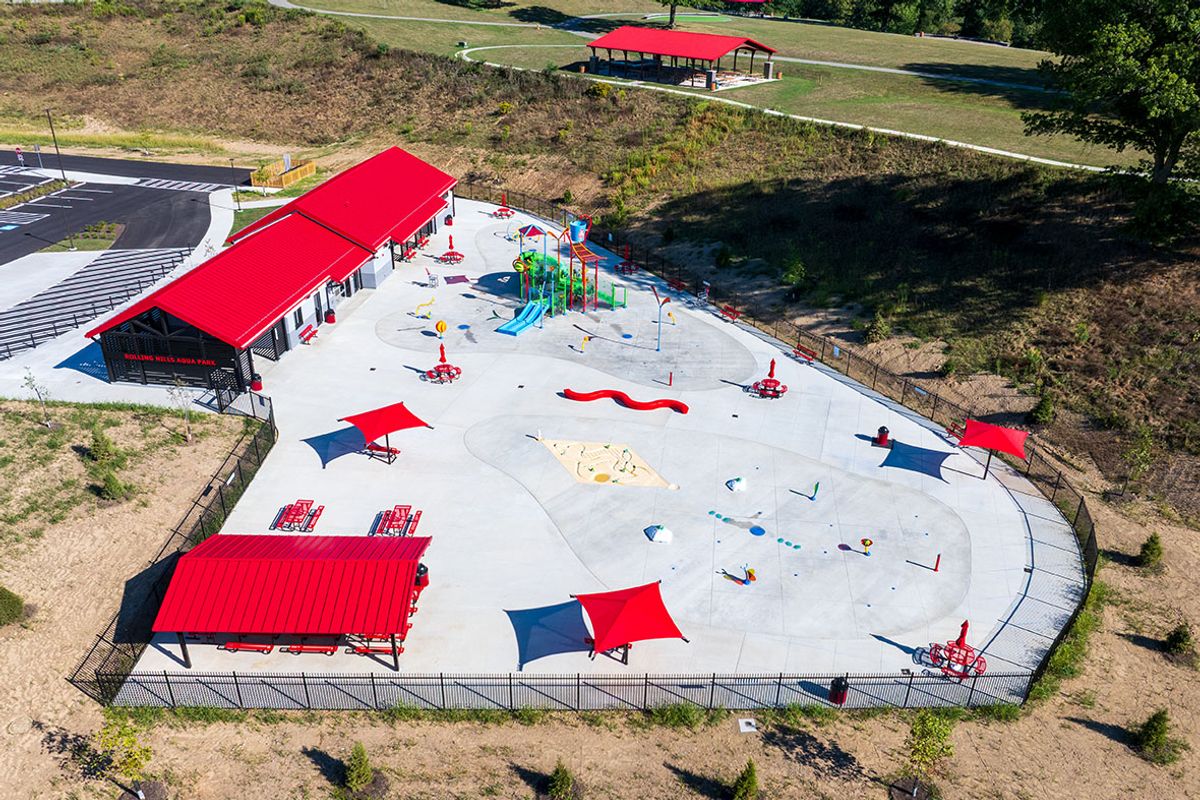
Walk through the gates and you arrive at the splash pad itself, which is really two playgrounds sharing the same sheet of concrete. The main attraction is instantly apparent.
Photography by Kimmel Architecture and Rob Benton
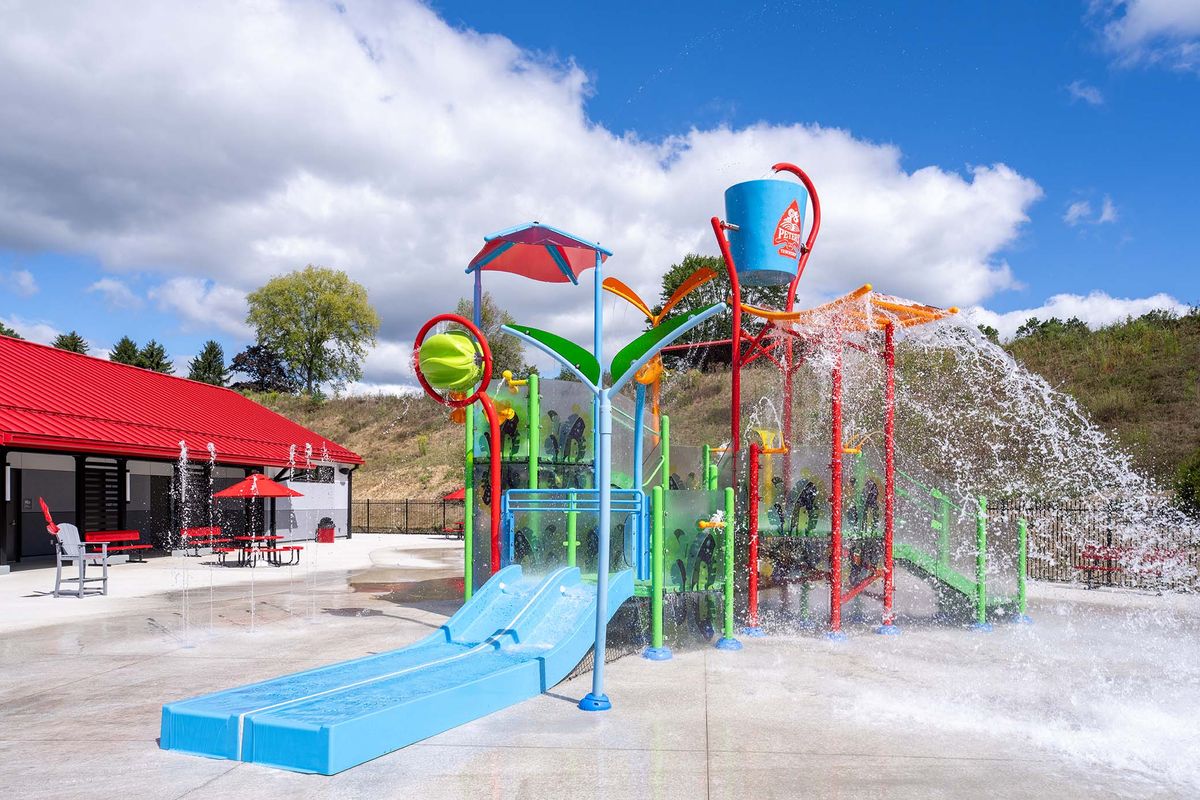
Rising left of center in a riot of primary colors is a play structure of carefully controlled chaos. Children climb a short set of stairs onto a network of small, elevated platforms that offer two possible routes back down. On one end is a pair of broad and insanely bright blue slides, which drop about three feet into a shallow pool. On the other is a much larger enclosed green tube whose descent offers several sick turns.
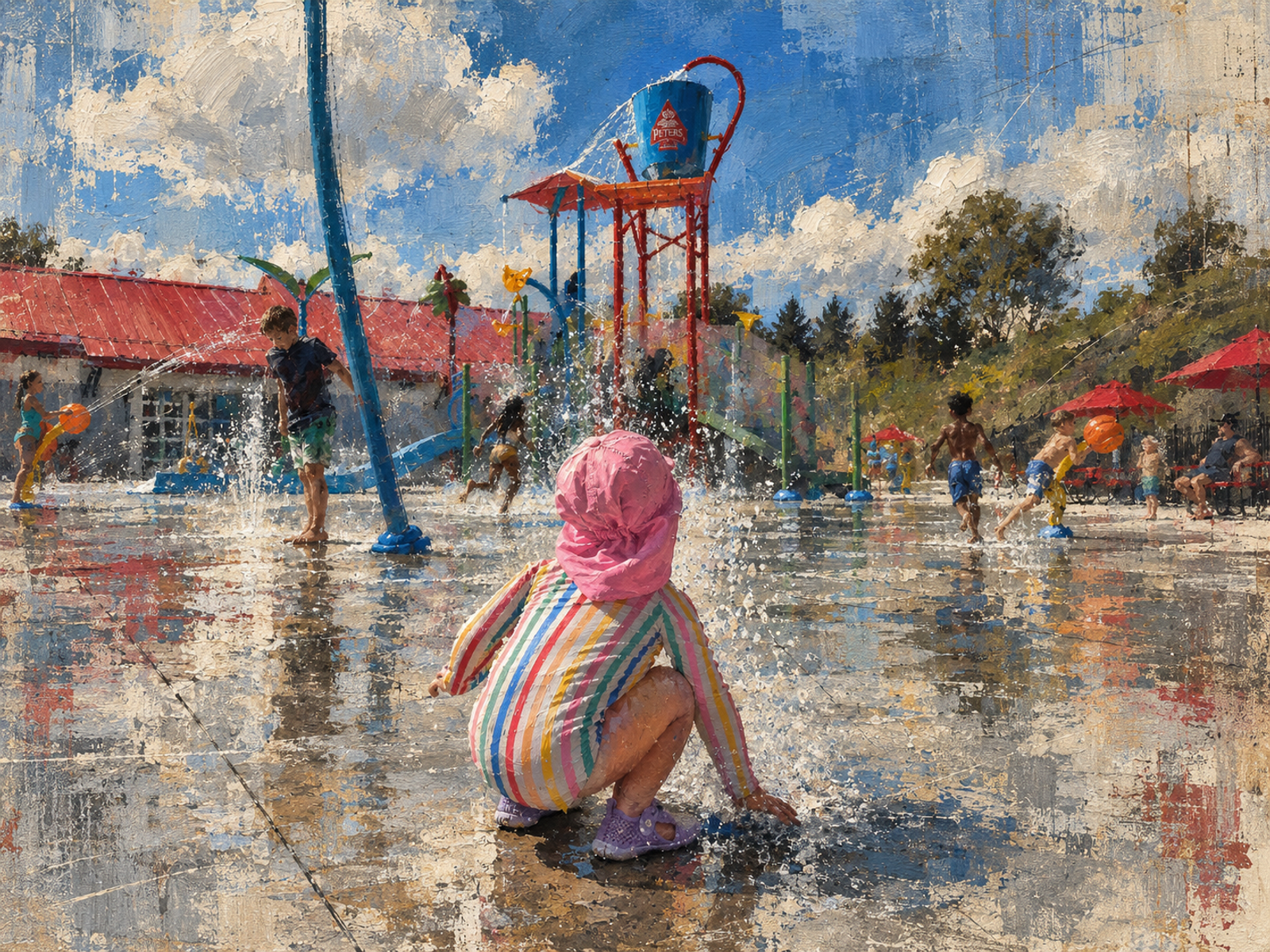
Anyone who enters get bombarded with water. Sprayers fire from every angle and gallons spill from elaborate overhead fixtures. Lording over it all is the pièce de résistance: an enormous blue tipping bucket, emblazoned with the Peters Township seal and perched atop a red frame high above the pad.
This 55-gallon monument to gravity takes on water until the balance becomes untenable, pitches forward and unleashes its contents onto the screaming children below. Then it rights itself and begins again.
Photography by Kimmel Architecture and Rob Benton
Even as a 43-year-old man, you cannot help but whisper: this looks awesome. Paul laughs and agrees. He tells you that at the ribbon cutting, him and Dave celebrated by being the first to get crushed by the bucket.
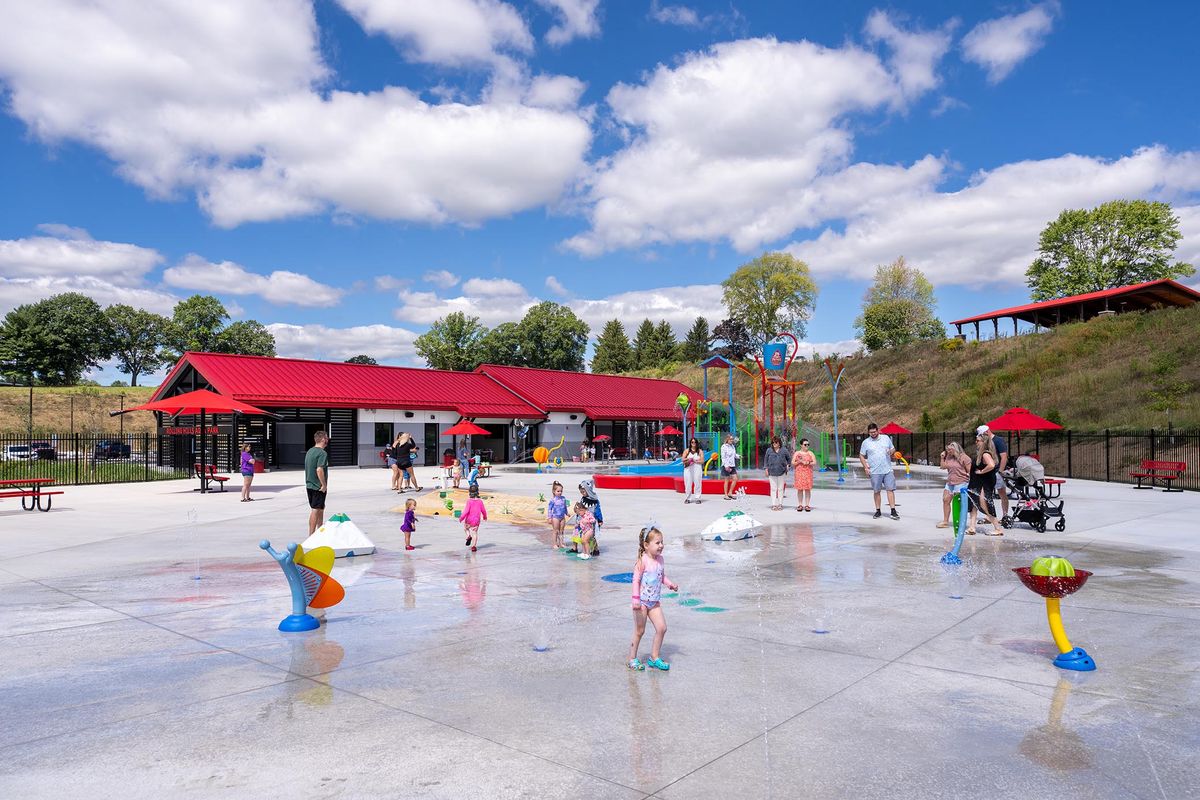
To the right, the experience changes gears. Here the design gives way to a collection of smaller curiosities arranged with generous space between them. Fountains bubble directly from the pavement. Low white mounds rise from the surface and send water cascading down their sides. Nothing towers overhead and children are instead free to wander from one encounter to the next, following whatever whims pop up in a toddler’s head.
Photography by Kimmel Architecture and Rob Benton
Additional touches within the park highlight the attention to safety. Shade is concentrated in the teensy area and sitting between the two zones are a series of backless curvy colorful low benches. These subtly define the boundary between the two play areas while also allowing parents with children in both age groups to sit between them and monitor the situations.
This is really well thought out, you tell Dave and Paul. They agree and credit the architect’s attention to detail. You should talk to him, Paul says.
Later on, you will. His name is Martin Kimmel, and he’s the President and Chief Creative Officer at Kimmel Architecture in Blue Bell. You ask how a Philly firm ended up with a Peters’ project. Kimmel tells you his team does plenty of municipal work across the commonwealth, designing town halls, libraries, police stations, and municipal buildings.
He says their approach is to always have something that looks upscale and fits into the community, no matter the budget. They have succeeded admirably here.
But underneath the pads there must be a complex web of pipes. How does the water circulate, you ask Dave. Oh boy, he says. Before they put the concrete in you had this maze of pipes out there. It was incredible. He forgets the exact footage, but it was quote: more than I would have ever conceived of.
He points at a big blue circle on the ground and tells you there are several of these scattered across the pads. They collect the water and send it down to a 6,000-gallon reservoir. From there, it gets pumped back into the filtration treatment room, where it runs through sand and chlorine before being sent back outside.
Matt Kuban, Massaro’s project manager for the build, will eventually tell you that this was the trickiest part of the build. They first excavated the area and ran the underground water lines to the precise locations of each planned feature, with individual lines sized and positioned according to what would eventually sit above them.
Once the piping was in place, crews filled and graded the site, burying the network beneath the surface. Then the individual splash-pad sections were poured over that, carefully lining the water features up with the pipes terminating below. Only after those pads were in place did Massaro begin pouring the larger concrete deck around them and they were working on water features while pouring the pool deck.
Getting concrete to the back corner behind the splash pads was a delicate challenge but the real pain point was the mechanical room, Kuban tells you. Banks of gray piping climb the walls and split into individual branches, each fitted with its own valves, wiring and controls, while larger pipes connect the system to pumps, filtration equipment and the water returning from the pad.
Construction took about eight months from start to finish, and the park opened in August of ‘25. The architect, GC, and town were all extremely complimentary of each other, attributing the successful build to mutual respect, high levels of communication, and all parties doing what is right by the town.
Paul himself said, quote: it’s a great design. The contractor’s execution was spot on. The town council should get a lot of credit for having the foresight to invest in this kind of project, and the staff who managed the build did the yeoman’s job in getting it up and running.
This isn’t a sexy build. You know that. In fact, it was relatively simple. But that ease was a second order effect of tremendous care, attention to detail, and good planning. That last one seems to be a hallmark of Peters.
Paul tells you that the township has been growing his entire tenure and they are constantly planning ahead. One nugget stands out: every new house or commercial development pays an impact fee intended to help address the traffic it creates. Lauer says those fees have generated a couple million dollars for transportation improvements, allowing Peters to pursue road and intersection projects that might otherwise be difficult to fund.
That’s interesting, you think. Growth is chess, not checkers. It’s one big system with a hundred inputs. Sewers are one, roads another, and parks are strategically important, too. Syncing them can take decades.
Two days later, and you can resist no longer. You pack your wife and daughter into the van and head to the splash pad. Upon entry, your wife says quote: oh, this is nice. Within fifteen seconds your daughter is gone, racing around the toddler zone. A few minutes later she has three new friends, and they jump from sprinkler to sprinkler sharing toys and splashing each other.
You and your spouse get to sit in the shade and watch men your age stand under the bucket with their kids and get dumped on. Your daughter is too young for that, but you wander over solo and take the hit. It’s everything you dreamed.
Your wife comments that this is incredibly relaxing. You agree. All around is the sound of laughter. Screams. And you don’t have to do anything. A fence keeps everyone in; there’s no dangerous deep ends and rowdy play is confined to a single side. Parents eyes surround the area. God be praised, the shade is incredible.
One hour of stress-free parenting. It cost $14. You would’ve paid triple that. You tell your wife that Lauer told you that they’ve hit capacity and people had to wait at the gate like it was a New York City nightclub. That Kimmel told you the biggest problem townships have after they build these is that they wish they built them bigger. She says she can see why.
You can see your daughter wherever she goes. Occasionally she looks up to make sure you’re still there. You wave. She waves back. Then she runs off again with her new friends. A glimpse into the future.
The next ten years have been on your mind a lot more lately. You currently live in Bridgeville, where the population has been steadily declining for decades. It’s nice, you like Bridgeville, but since the birth of your daughter, you’ve noticed some things that trouble you.
And at this precise instant, you realize you are not researching the great in-migration from afar. You are living it. So is everyone around you. It is quietly shaping everything about how this region functions and will function in the coming decades.
And there will be winners and there will be losers.
Massaro completed the build in eight months, enabling the park to open in August. More than 16,000 visitors passed through the gates during the Aqua Park’s first full season, which really only lasted until September. Those are strong numbers.
Daily attendance climbed as high as 750. On more than one occasion, the park has gone viral on Pittsburgh mom Instagram. To Lauer and Brooks amazement, guests have come in busses from far off places like Squirrel Hill and Cranberry.
The park sold 2,500 day passes to Peters residents. Incredibly, it sold 4,500 to non-residents. Every one of them had to pass grocery stores and restaurants and nice rural neighborhoods to get there, and every one of them would see the sleek and expansive new high school when they pulled in.
Later, your daughter works up the courage to enter the big kid zone.
BIG STEP she roars as you help her ascend. She howls with laughter and holds tight to your leg as water envelopes you both. Eventually, she works up the courage to take on the blue slide and then immediately exits and you both run back to do it again. Then again. And again. And again.
Amidst this chaos, it occurs to you that these might be some of the best moments of your life.
One hour of stress-free parenting. It cost $14. You would’ve paid triple that.
Later still, she’s exhausted. Bed-time was a breeze. Now you’re on the couch, figuring out just how to convey the importance of this splash pad in a project profile. You tell your wife you have a crazy idea but you’re not sure if the readers will like it. She tells you to trust your gut but is browsing Zillow and too busy to really engage.